Friday, May 02, 2008


Monday, March 31, 2008
Tale of two cities
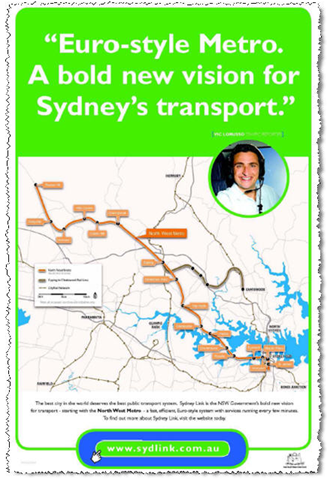 | In New South Wales, commuters are being asked to imagine a 'Euro-style Metro' as the future horizon for Sydney's troubled transport system. 'Euro' here signifies a system which is slick, clean, efficient. |
 | While in Melbourne, The Age newspaper tried to publicise the transport woes with the image of the new train system in Delhi, India. It says: |
AS MELBOURNE tinkers with its largely pre-World War II public transport system and puts up with congested roads, commuters in the Indian capital, New Delhi, are revelling in a state-of-the-art Metro
So what's it going to be? Euro or Indian? While Euro might be more familiar, I think there's more to learn on the train to Delhi.
Sunday, March 09, 2008
Octave Mannoni

...it would not be over-bold to foresee in the distant future the development of a new kind of white or near-white humanity over almost the whole of the southern hemisphere of the ancient world, a type more different, psychologically, from that of the north than any of the northern peoples are from each other from east to west. If national psychologies remain as constant as appears to be the case, we can already forecast what the main characteristics of this new type will be: lack of originality and creativity, a distinct taste for feudal types of organisation, and a lively desire to avoid infection from the complexes of the northern hemisphere… the new white or near-white (white enough at any rate not to feel inferior in the southern hemisphere) human beings I have envisaged would on the whole be far less worthy products than are Europeans, unless as a result of having to grapple with fresh difficulties they acquired some qualities other than mere pride in the race of their birth.
Octave Mannoni Prospero And Caliban: The Psychology Of Colonization (trans. Pamela Powesland) Ann Arbor: University of Michegan Press, 1990, p. 128
There's always awkwardness in engaging in these terms of debate. The future of 'white peoples' evokes the racist discourse associated with laws such as the White Australia Policy. However, the argument is worth considering. According to Mannoni, the sense of superiority felt by colonists retards their development. They are complacent in their righteous culture and resist innovation.
Those of us in Australia who have just emerged from the Howard era might find an echo of truth in his analysis. The challenge now is to find sources of cultural change in the recent recognition of culpability. Rather than a simple squaring of accounts, it should be followed by a critical examination of the settler experience. If we are not returning back the land that we stole, what productive use are we going to find for this ill-gotten gain?
Tuesday, February 26, 2008
A 'Dirty Mile' through the enchanted forest
Ilbijerri Theatre have developed a tour of Fitzroy's Gertrude Street, highlighting the Koori Sites of Significance. Based on a concept of the late Lisa Bellear, actors take the audience along time and space, from the original European contact in the Carlton Gardens to the infamous Charcoal Lane, the site of Archie Roach's song.
While there, audience members were given pieces of chalk and asked to leave messages. If you click on the image, you can get a larger version that will be easier to read.
It's a quite an intimate and visceral theatre, with audience being constantly herded along streets. Sometimes, the passersby look as though they could be extras, but that's Fitzroy for you.
The underlying story of repression and resilience. It's a powerful counterpoint to the commercial image of Gertrude Streets, which consistently evokes the European forest.
I imagine it's hard to get tickets for this season, but well worth the try.
Sunday, February 17, 2008
Kosovo at last
Here's the Victorian Herald-Sun from 17 May 1999, when the Premier Jeff Kennett greeted refugees from Kosovo in the Albanian language. That was when Australians embraced these people and presented an image of this wide brown land as an open-hearted refuge for persecuted peoples.
We lost the plot for a while. The shock jocks and Pauline Hansen made sure the Kosovars did not outstay their welcome. Howard cultivated a xenophobia towards refugees. But now we have a 'new page', so let's hope we can recover that sense of welcome that we extended back in 1999.
And today, Kosovo will finally be granted independence. Albanians in Australia have fought long and hard for this day. Congratulations. The struggle of great figures like Ibrahim Rugova has been worth it. There are many challenges ahead, but destiny is now in your hands.
Urime!, Përgëzime!
Smooth the pillow?
Inge Glendinnen is a widely-respected intelligent writer who has described with great care and sensitivity the workings of cultures as distant from our own as the Aztecs. She was recently a strong supporter of the Federal Government 'intervention' in Northern Territory. Her post-Howard article in The Age is cause for some concern.
She writes about the harsh and violent conditions in the most remote Aboriginal communities. Invoking the term 'self-modernisation', she sees intervention as a matter of giving Aboriginal people the choice to either stay with their isolation or become more like everyone else. She admits, this might see the end of Aboriginal culture:
The next decade might see the end of that most obdurate element of Aboriginal "resistance": their determination, sustained since first contact, to remain themselves by living among themselves. Should that happen, it will become our duty to measure and mourn what we, and they, have lost.
It's an extremely sensitive issue, but lurking at the back of Glendinnen's remarks is the idea that the responsibility of whitefellas is to 'smooth the pillow of the dying race' -- expressing sadness at the loss of these people, but complying with a positivist model of civilisation and the ultimate dominance of Western culture. That may seem harsh, but is there another way to look at it?
Wednesday, February 13, 2008
A beautiful sorry morning
On a cool summer morning, someone said 'sorry'. He spoke of 'non-indigenous' Australians as 'them'. He attributed total responsibility to government. It's an inspiring beginning, but where will we go from here?
Given the emotion of the day, what seemed most powerful about Kevin Rudd’s apology to the Stolen Generations was respectful silence that accompanied it. Despite the personal traumas experienced directly and witness associated with the policy of racial assimilation, there seemed little display of emotion in the actual presentation of the apology. Rudd’s faltering delivery was workmanlike. Bob Hawke would certainly have been in tears. For today, emotions can wait. Let’s get the business over first.
It’s a defining moment in the ‘new chapter’ of Australia. In laying blame for the Stolen Generation, Rudd was careful to exempt those who carried out the policies. Instead, he attributed responsibility to the parliament who framed the legislation. He ended by inviting the leader of the opposition to join him in a commission that would ‘change the way Australians think about themselves.’ While today is critical in the unfinished story of reconciliation, it is also a day for asserting the authority of government. Is this good for the culture of a nation? Should government be the only conduit for change?
One very reassuring aspect of Rudd’s speech is the way he addressed ‘non-indigenous Australians’. He spoke of ‘them’ in the third person, just as he had the ‘Indigenous Australians’. This was critical. If he has spoken of ‘us’, then it would have been another post-colonial confession admitting past wrongs but maintaining the dominant position. There was a relatively equal place in Rudd’s language for both Indigenous and non-Indigenous. Of course, this does not reflect the inequalities between the two—the economic superiority of whitefellas and the cultural richness of Indigenous Australians. But we can begin to think of them as in dialogue with each other.
In terms of Australia’s recent history, there was a sense of historic justice in the focus on the white Australian practice of stealing children from their families. In recent years, we’ve experienced a number of xenophobic scandals associated with acts like Tampa that have focused on disregard for children as the ultimate sign of being ‘unAustralian’. Yet here, at the core of Australian history, is an official practice of breaking apart families.
‘Turning the page together’ on a ‘new chapter’ in Australia’s history, it’s a wonderful morning for us all. It’s a good moment to start thinking anew about the relationship between Indigenous and non-Indigenous identity.
__
Melbourne Forecast
Issued at 4:50 am EDT on Wednesday 13 February 2008
Fine apart from a brief shower or two this morning. Partly cloudy with a moderate to occasionally fresh southerly wind.
Precis: Clearing shower or two.
City: Max 20
Sunday, January 20, 2008
The flame of civilization

I've just finished reading Tropical Truth, but Brazilian singer Caetano Veloso. It's an extremely contentious, but inspiring witness to the creative energies around the nexus of art and music in 20th century Brazil.
Like many other Brazilian artists, Veloso's work seems borne of the struggle against the exoticisation of the south. Rather than present the South as primitive other to the rational North, he advocates a continuity of the rationalist project, albeit with a detour:
The great movement that carried the flame of civilization from the globe's warm regions into the cold of the northern hemisphere - thence on to Japan and the neocapitalist Asian tigers and neocommunist China - this movement is ripe for a detour. And it may have as its horizon a myth of Brazil - the American, Lusophonic, mestizo giant of the southern hemisphere.
Caetano Veloso Tropical Truth: A Story of Music & Revolution in Brazil New York: De Capo Press, 2002 (orig. 1997), p. 324
There's a reasonable quota of Lusophone mysticism in the book. But it results in a dense creativity, woven in the dialogue between musicians and artists and through samba, Bossa Nova and Tropicalismo. How can we connect this to other creative energies in the South?
Friday, January 11, 2008
Where is a Melbourne of the north?
The Age editorial (7/1/2008) advocated for Melbourne's position as the next UNESCO City of Literature by seeing that the city could be a mirror of the north:
In this respect, Melbourne has all the qualifications to be the Edinburgh of the south: our rich literary tradition, nourished by support from writers and readers but also from government and local government, sets the stage or builds the shelf (pick your metaphor) for this city to be a national and international centre for literature and all its offshoots.
Melbourne: city of literature and literacy - Editorial - Opinion - theage.com.au
This phrase 'x of the south' subscribes to a model of the world where the origins exist on the north, and it is left for those cities in the south like Melbourne to aspire to be like them.
I like Fergus Hume's citation, in the world's first detective novel, set in Melbourne.
Some writer has described Melbourne as Glasgow, with the sky of Alexandria; and certainly the beautiful climate of Australia, so Italian in its brightness, must have a great effect on the nature of such an adaptable race as the Anglo-Saxon… Climatic influence should be taken into account with regard to the future Australian, and our prosperity will be no more like us than the luxurious Venetians resembled their hardy forefathers, who first started to build on those lonely sandy islands of the Adriatic.
Fergus Hume The Mystery of a Hansom Cab Melbourne: Sun Books, 1971 (orig. 1886)
While Melbourne aspires alternatively to be a Glasgow or Edinburgh of the south, is there a town in Scotland that is one day hoping people will call it the 'Melbourne of the north'?
Wednesday, January 09, 2008
The limits of mateship

An enduring image of the last-minute Australian victory over India in the second Test was the wild celebrations by the triumphant cricketers. While excited to embrace and cavort with their 'mates', none of the Aussies sought a sportsmanlike handshake with the Indian batsmen who had contributed to the exciting finish. This has caused outrage in not only in the sub-continent, but Australia as well. It highlights the paradox in the value of mateship, which brings together white men in a bond of camaraderie, though casts a shadow over those who are considered foreign. It includes by excluding.
It's the same kind of mistake that occurs in the Australian colony in Paraguay. Though built on the ideal of a fellowship of man, it cast the darker man as an enemy.
The assumption that Anglo-Saxons were inherently superior to Hispano-Indians was as much a part of the colony's creed as teetotalism, a principle which had also been made explicit in the New Australia articles of association, but was now an unwritten law. The racial attitudes the colonists had brought with them from Australia were revealed by some of the facetious advertisements in Evening Notes: 'Boycott the Chinkie and save yourselves from the Yellow Agony by buying your vegetables from white gardener -- John Wilson'; 'Baxter's shoes - Nigger tickler clogs.'… this was not gracious, for on the whole Cosme fared well in its deadlings with the Government of Paraguay.
Gavin Souter A Peculiar People: The Australians In Paraguay Sydney: Sydney University Press, 1968
But this is clearly not representative of all Australians. Counter-balancing this xenophobic mateship is a 'fair go' egalitarianism that assumes all are equal. Let's hope this value is encouraged by the conflict between Australia and India, rather than deepening trenches.
Monday, December 31, 2007
An Advanced Diploma in Mumbo Jumbo
As part of what's been heralded as 'new Southern Studies', a number of critical texts have been focusing on the unacknowledged inheritance of African values in the American South. These texts have something to offer not such for an understanding of American culture, but for cultures like Australia that have been influenced by the dominant force.

The question here is what happened when the growing racial ideologies behind American 'Samboism' clashed with the reality of a literate Muslim slave presence in America. The presence of literate, black African Muslims as slaves in American often caused moments of doubt, challenge, and embarrassment to supports of a racial justification of slavery. (p. 160)
Threaded throughout Cartwright's book is a series of Africanisms - words from Senegambian culture that have become part of the American idiom. He ends the book with a call for a recovery of these African roots:
As we work to read Africa and Africanist ideologies into their long-standing core position in American identity, culture, and literature, we are taking a step toward finding historical truth and needful balm for festering, long-ignored wounds. And as we come to respect some of the energies of action channeled through the pharmacopoeia of the Senegalese mocho'o (medicine worker), we make return to the vital work of treating the foundational 'mojo' of transatlantic chattle slavery, a 'mojo' that is (in its ever-rippling causes and effects) a source of the nation's most enduring curses and simultaneously a source of our peculiarly American genius. (p. 229)
Friday, December 21, 2007
Official: Australia is not the 'biggest in the Southern Hemisphere'
Image from recent demonstration to keep North Melbourne football club in Victoria.
In Australia, we are keen to boast our various claims to be the 'biggest in the Southern Hemisphere.' Googling this phrase in English reveals 3,840 instances on the Internet (by comparison, ‘biggest in the Northern Hemisphere’ is only mentioned 8 times). The subjects of this claim include cultural activities (Scottish Highland Festival, temple and casino), sports (rodeo, triathalon and marathon) and man-made structures (desalination plant, drive-in and telescope).
With the aid of Google, it is possible to test whether Australia’s boast is the most common in the Southern Hemisphere. To search for the equivalent phrase in Spanish produced only 1,530 hits, however the Portuguese had 4,690. A sampling of country references in the three languages, weighted by the frequency of language, reveals the following table of claims in order of percentage frequency:
| COUNTRY | CLAIMS |
| Brazil | 44% |
| Australia | 21% |
| South Africa | 16% |
| New Zealand | 6% |
| Argentina | 4% |
| Multinationals | 4% |
| Chile | 2% |
| Pacific | 2% |
| Other African | 2% |
Given the population and economy of Brazil, it is no surprise that it has twice as many claims as Australia. While putting Australia in its place, this table does prompt us to consider Australia as part of a community of nations inhabiting the South. But what do they share in common apart from this aspirationalism?
Thursday, December 13, 2007
Is there a South for Rudd?
The first days of the Rudd government have revealed an interesting exclusion. In discussing the appointment of West Australian Stephen Smith as Foreign Minister, Rudd claimed:
This nation doesn't just look east, it looks north and it looks west.
That's three directions. Is there another direction missing?
Then in 12 December, Rudd greeted with the world with a stirring declaration of the new government's commitment to global cooperation over climate change.
As our host, President Yudhoyono, said to me when we met yesterday, there can be no North or South, given the dimensions of this challenge. Together we are custodians of the planet.
It seems an important and inevitable gesture to take a united perspective. And it's a wonderful role for Australia play as a mediator between North and South. But this role can only be successful if Australia is sensitive to the history of the South and its suspicion of the North.
Someone, somewhere, decided that there would be a North and a South. And that North would be above South. It doesn't mean that they can't work together. But can we deny the difference?
Friday, November 30, 2007
Chairman Rudd slays the dragon

There is a Chinese saying: 'In order to obtain the pearly necklace from the dragon, it is first necessary to find the man to slay the dragon.' Everything is to be done in the correct way and in the correct sequence.
Kevin Rudd has slayed the dragon.
A lifelong Sinophile, Kevin Rudd seems a kind of Anglo-Irish version of a Chinese leader. His victory speech was epic and formalistic - 'this, our great nation'. And he call for fellow MPs to visit homeless shelters has a sound of the cultural revolution about it.
With a nation of such uncertain identity as Australia, it seem to be an easy host for alternative cultural paradigms.
The previous Labor rule under Bob Hawke was characterised by the Scandinavian model. The success of the Accord on which a stable industrial relations was built came from visits to the Volvo factories in Sweden.
So how will Australia now develop under the Chinese model? We've had the battle between cosmopolitanism and parochialism in the dispute between Keating and Howard. Now what will happen to ideological divides?
Will Rudd transcend this with a Confucian respect for hierarchy married with a revolutionary sense of urgency? While it promises an Australia that is more open to the world (not confined by global elites as under Keating), there is the danger that it brooks no argument. Urgency may be used to avoid an acknowledgement of difference, whether ideological or cultural.
We are now on the verge of a bright and glorious future for this, our great nation, under the leadership of our new shiny Prime Minister. Let a thousand laptops bloom.
Monday, November 05, 2007
Nation 'too parochial' to engage - Merewether's lament
The curator of last year's Sydney Biennale Charles Merewether has just taken a job as deputy Director of a $33 billion new cultural district in Abu Dhabi. He leaves embittered by the response to his biennale:
Merewether says he is disappointed by "the lack of residue, the lack of ongoing discussion" it instigated.
"We may have failed to distinguish issues that could be discussed in an ongoing manner. I had hoped, for instance, that the work from the Middle East might have raised issues about what is going on there, culturally and artistically. Likewise with work from the Balkans. But in the end, it had no traction. It was if it were all just a passing event, a fashion.
Nation 'too parochial' to engage | The Australian
The problem is not that Merewether's was too radical for Australia, it was too predictable. The biennale colluded with a seeming noble interest of western liberals in the plight of those in transitional zones, such as the Middle East or the Balkans. But such an interest presumes a pity for those who are unable to enjoy the benefits of the west. There is nothing in this art that conveys the validity of the culture from whence it arises. It is simply there to attract our victimist gaze. The biennale thus left its audience feeling just as 'relaxed and comfortable' as it was before. The fact that it included 'difficult' issues like the MIddle East does not mask its globalised position.
For the biennale to be more than fashion, we needed to see something of ourselves as visitors in the picture, to understand our own place in this world. Without that, the world is just 'an amazing place'.
Thursday, October 04, 2007
Time to start a Black Party in Australia
While the Australian Minister for Immigration Kevin Andrews made the decision to cut the refugee intake form Africa a few weeks ago, he has come out now to politicise the issue, no doubt with the whiff of an election in the air. The xenophobia card has got the Liberals out of jail before, when the Tampa crisis raised the spectre of Australia being flooded with Middle Eastern refugees.
Now the art of 'double speak' that cutting this intake is designed to protect the immigration program:
A day after conceding that a failure of African migrants to "integrate" into Australian society had prompted the decision, Mr Andrews told journalists in Melbourne he was acting to maintain community confidence in Australia's immigration program.
Andrews releases 'evidence' - National - theage.com.au
Andrews' evidence is vague and repeats the allegations that have been made towards other refugee groups in the past, such as the Vietnamese. Naturally, the opposition have followed their Liberal Lite strategy and backed Andrews on this kind of discrimination.
It's a very sad state of politics where the two major parties feel they have to appeal to the racists and selfish instincts of the population. For Australia to continue as a white fortress is to cut the nation off from the world and to create a false sense of complacency.
Thankfully the church has come out:
Reverend David Pargeter, from the Uniting Church's Synod of Victoria and Tasmania, said: "When a Government minister, on the eve of an election, connects violent action with one particular cultural group, we know we have reached deeply into the darkness of racial politics."
Minister's African dossier renews racial tensions
As the Greens Party promotes the cause of the environment, it would be good to have a political voice that specifically championed an open Australia, that celebrated its multicultural fabric with a generosity and openness that has marked other great nations of immigration. If there was a Black Party, which had a broad platform of cultural dialogue, both in Indigenous and migrant voices, I would certainly support it.
Monday, September 17, 2007
Flower power in Melbourne


Sunday, August 26, 2007
The dark side of Australian politics
With the re-entry of Pauline Hanson into Australian politics, we are seeing the return of the kind of meanness that is determined to protect white privilege. Here she is on ABC radio:
DONNA FIELD: Ms Hanson says she knows a lot of white South Africans who have immigrated to Australia, and they've been subjected to medical tests. But she's concerned the same can't be said for black Africans.
And on queue, Minister for Immigration and Citizenship Kevin Andrews issued a press statement that refugee intake from the African region would be reduced to 30 per cent, with a likely further reduction in the future. Let's hope that someone can let some light into the white fortress.
Saturday, August 18, 2007
São Paulo unveiled

Under the control of its mayor Gilberto Kassab, São Paulo has implemented a Lei Cidade Limpa or Clean City Law, which outlaws outdoor advertising. Kassab argues it is part of an anti-pollution campaign:
The Clean City Law came from a necessity to combat pollution . . . pollution of water, sound, air, and the visual. We decided that we should start combating pollution with the most conspicuous sector – visual pollution.
Adbusters : The Magazine - #73 Carbon Neutral Culture / São Paulo: A City Without Ads
The advertising ban appears to be popular with the majority of Paulistas, though there are reports of people getting lost without familiar landmarks. The demolition of billboards has revealed strange scenes, such as Bolivian migrant communities. Some companies are responding by painting the outside of their buildings in bold colours reflecting their corporate image. Will this set a trend in the metropolitan centres of the south?
See for yourself in this short film.
Saturday, August 11, 2007
The end of the Rudd era
After his historic win against the long-standing John Howard in November 2007, Rudd has counterbalanced the political ledger with four terms at Prime Minister. But like his predecessor, the elusive fifth-term seems beyond his reach.
The Rudd era has seen a number of radical developments. Australia's close relationship with China has been the cause of much consternation, particularly given the country's poor record in carbon emissions and human rights in Africa. Kevin Rudd's support for China's invasion of Taiwan in 2015 has been the subject of growing protest.
The past eleven years have also seen a wholesale change in state politics, as Labor governments have all now succumbed to Liberal victories, leaving the Federal stage as the only remaining bastion of Labor power.
While initially supported as a fresh new leader, Rudd's popularism seems to have worn thin with both media and voters. For many years, his 'focus group' approach has been for long effective in countering Liberal opposition. But Rudd is now perceived as weak and lacking in vision.
Opinion polls in the middle of 2018 show a dramatic surge of support for the Liberal party, under its dynamic new leader Richard Howard, son of the former Prime Minister. Rudd is trying to counter this by a frantic series of new legislation, including Indigenous health support and a ban on old-growth logging in Tasmania. But to the cynical public, this is perceived as a desperate attempt to add vision now the end is nigh.
So what will Richard Howard be like as the new Prime Minister? Many critics see his close ties to the US as playing a major role. The recent election of Jenna Bush to the US Presidency has returned conservatives to power after years in the wilderness during Hillary Clinton's rule. Australia can once again turn to the US as its primary ally. Howard has already promised to boost Australia's already extensive troop commitments in the continuing war in Iraq.
And how long is Howard's reign as Prime Minister likely to last? Time will tell.