Showing posts with label Africa. Show all posts

Tuesday, July 29, 2008

Dark clouds not on the horizon

DSCF3964

Within the liberal classes, we have become so used to our own sense of tolerance and cosmopolitanism, we may be blind to the danger of complacent insularity from within.

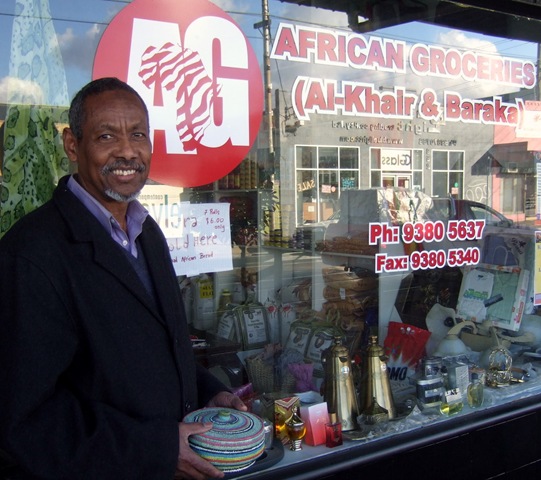
The People's Republic of Brunswick is a widely celebrated bastion of multiculturalism. After Italian, Greek and Arab, the latest region to add its culture to the suburb's diversity is African. In Lygon Street is the new store with goods and crafts from east Africa. Mahmoud Leman is here holding a bowl made by local Eritreans from recycled materials. His wife Halima Sheikhdin has been particularly involved in this activity.

I visited this store on my way to a 'town hall' meeting at the East Brunswick Hotel where a panel was discussing the latest plan for development in Brunswick. The hotel was packed to the gills with locals keenly interested to ensure that their suburb was protected from threats from outside. One of the proposals considered was a ring road to direct cars away from Brunswick.

Looking around at the crowd, it was hard to find anyone - including myself - who was not Anglo middle class. There were no Greeks or Africans present. While seeming noble in motive, reflecting a shared consensus in 'green' values, I couldn't repress a feeling of apprehension that this is a kind of middle class gentility whose hidden purpose is to ensure homogeneity. It's a terrible thought, which I attribute to some devil whispering in my ear. But I await the voice of the angel to dispute this.

And last night, I went to the surprise lecture of the next director of the Sydney Biennale, David Elliot. While celebrating 'impurity' in art, he actually contextualised this within the consciousness of the artist, rather than a critical engagement with impurity as we have seen in psychoanalysis or postcolonialism. The sense was that the free bohemian artist was above the crude divisions that exist in the world. This disengagement of art from the world (suggested partly in this year's Biennale) does not bode well for responses to climate change. Will re-localisation prove to create comfort zones for well-endowed elites?

Well, someone has to ask the question, if only to be proved wrong.

Monday, June 23, 2008

The Zimbabwe issue

The incessant stories of corruption, violence and ineptitude from the current Zimbabwe government make it impossible to consider that their position is based on anything other than self-interest.

But there's always another point of view. Where would it be? Try listening to the BBC interview with the Zimbabwe information minister Ndlovu. At one point, the interview hectors the minister 'Well, it's practice in our country to asks questions of the politicians!' The tone was so redolent of imperialism, you could understand how the present government is able to sustain its belief that the colonials are still a threat.

There may be many more stories about Zimbabwe that we never get to hear. It makes you wonder if the news blockade is not so much about information getting into Zimbabwe as anything other than the story of chaos emerging from Zimbabwe itself.

Monday, December 31, 2007

An Advanced Diploma in Mumbo Jumbo

As part of what's been heralded as 'new Southern Studies', a number of critical texts have been focusing on the unacknowledged inheritance of African values in the American South. These texts have something to offer not such for an understanding of American culture, but for cultures like Australia that have been influenced by the dominant force.

I've just finished Keith Cartwright's Reading Africa Into American Literature: Epics, Fables, and Gothic Tales (Lexington: Univ. of Kentucky Press, 2004). It's a fascinating analysis West African roots. Cartwright covers the Uncle Remus stories, Creole languages, second-sight and Senegambian values. Especially interesting is his analysis of the way literate Muslim slaves were treated. While early in the history of the south, their education was respected and many were freed, in a later more racist time their learning was demeaned. A product of this 'mumbo jumbo', which is still alive as a denigration of African learning. The inscrutable Arabic text became a symbol of primitive mystification:

The question here is what happened when the growing racial ideologies behind American 'Samboism' clashed with the reality of a literate Muslim slave presence in America. The presence of literate, black African Muslims as slaves in American often caused moments of doubt, challenge, and embarrassment to supports of a racial justification of slavery. (p. 160)

Threaded throughout Cartwright's book is a series of Africanisms - words from Senegambian culture that have become part of the American idiom. He ends the book with a call for a recovery of these African roots:

As we work to read Africa and Africanist ideologies into their long-standing core position in American identity, culture, and literature, we are taking a step toward finding historical truth and needful balm for festering, long-ignored wounds. And as we come to respect some of the energies of action channeled through the pharmacopoeia of the Senegalese mocho'o (medicine worker), we make return to the vital work of treating the foundational 'mojo' of transatlantic chattle slavery, a 'mojo' that is (in its ever-rippling causes and effects) a source of the nation's most enduring curses and simultaneously a source of our peculiarly American genius. (p. 229)