Thursday, October 04, 2007

Time to start a Black Party in Australia

While the Australian Minister for Immigration Kevin Andrews made the decision to cut the refugee intake form Africa a few weeks ago, he has come out now to politicise the issue, no doubt with the whiff of an election in the air. The xenophobia card has got the Liberals out of jail before, when the Tampa crisis raised the spectre of Australia being flooded with Middle Eastern refugees.

Now the art of 'double speak' that cutting this intake is designed to protect the immigration program:

A day after conceding that a failure of African migrants to "integrate" into Australian society had prompted the decision, Mr Andrews told journalists in Melbourne he was acting to maintain community confidence in Australia's immigration program.
Andrews releases 'evidence' - National - theage.com.au

Andrews' evidence is vague and repeats the allegations that have been made towards other refugee groups in the past, such as the Vietnamese. Naturally, the opposition have followed their Liberal Lite strategy and backed Andrews on this kind of discrimination.

It's a very sad state of politics where the two major parties feel they have to appeal to the racists and selfish instincts of the population. For Australia to continue as a white fortress is to cut the nation off from the world and to create a false sense of complacency.

Thankfully the church has come out:

Reverend David Pargeter, from the Uniting Church's Synod of Victoria and Tasmania, said: "When a Government minister, on the eve of an election, connects violent action with one particular cultural group, we know we have reached deeply into the darkness of racial politics."
Minister's African dossier renews racial tensions

As the Greens Party promotes the cause of the environment, it would be good to have a political voice that specifically championed an open Australia, that celebrated its multicultural fabric with a generosity and openness that has marked other great nations of immigration. If there was a Black Party, which had a broad platform of cultural dialogue, both in Indigenous and migrant voices, I would certainly support it.

Monday, September 17, 2007

Flower power in Melbourne

Today I visited the Tulip Festival in Silvan. Though originally a Dutch festival, it has now a very strong Turkish flavour. The program featured some very impressive performances by local Turkish dancers and performers. Strangely, the day seemed to be attended mostly by Indians. A Dutch festival performed by Turks and watched by Indians -- only in Melbourne!
Posted by Picasa

Sunday, August 26, 2007

The dark side of Australian politics

With the re-entry of Pauline Hanson into Australian politics, we are seeing the return of the kind of meanness that is determined to protect white privilege. Here she is on ABC radio:

DONNA FIELD: Ms Hanson says she knows a lot of white South Africans who have immigrated to Australia, and they've been subjected to medical tests. But she's concerned the same can't be said for black Africans.

And on queue, Minister for Immigration and Citizenship Kevin Andrews issued a press statement that refugee intake from the African region would be reduced to 30 per cent, with a likely further reduction in the future. Let's hope that someone can let some light into the white fortress.

Crikey - Politics - Pauline whistles, Howard jumps. Again

Saturday, August 18, 2007

São Paulo unveiled

Under the control of its mayor Gilberto Kassab, São Paulo has implemented a Lei Cidade Limpa or Clean City Law, which outlaws outdoor advertising. Kassab argues it is part of an anti-pollution campaign:

The Clean City Law came from a necessity to combat pollution . . . pollution of water, sound, air, and the visual. We decided that we should start combating pollution with the most conspicuous sector – visual pollution.
Adbusters : The Magazine - #73 Carbon Neutral Culture / São Paulo: A City Without Ads

The advertising ban appears to be popular with the majority of Paulistas, though there are reports of people getting lost without familiar landmarks. The demolition of billboards has revealed strange scenes, such as Bolivian migrant communities. Some companies are responding by painting the outside of their buildings in bold colours reflecting their corporate image. Will this set a trend in the metropolitan centres of the south?

See for yourself in this short film.

Saturday, August 11, 2007

The end of the Rudd era

After his historic win against the long-standing John Howard in November 2007, Rudd has counterbalanced the political ledger with four terms at Prime Minister. But like his predecessor, the elusive fifth-term seems beyond his reach.

The Rudd era has seen a number of radical developments. Australia's close relationship with China has been the cause of much consternation, particularly given the country's poor record in carbon emissions and human rights in Africa. Kevin Rudd's support for China's invasion of Taiwan in 2015 has been the subject of growing protest.

The past eleven years have also seen a wholesale change in state politics, as Labor governments have all now succumbed to Liberal victories, leaving the Federal stage as the only remaining bastion of Labor power.

While initially supported as a fresh new leader, Rudd's popularism seems to have worn thin with both media and voters. For many years, his 'focus group' approach has been for long effective in countering Liberal opposition. But Rudd is now perceived as weak and lacking in vision.

Opinion polls in the middle of 2018 show a dramatic surge of support for the Liberal party, under its dynamic new leader Richard Howard, son of the former Prime Minister. Rudd is trying to counter this by a frantic series of new legislation, including Indigenous health support and a ban on old-growth logging in Tasmania. But to the cynical public, this is perceived as a desperate attempt to add vision now the end is nigh.

So what will Richard Howard be like as the new Prime Minister? Many critics see his close ties to the US as playing a major role. The recent election of Jenna Bush to the US Presidency has returned conservatives to power after years in the wilderness during Hillary Clinton's rule. Australia can once again turn to the US as its primary ally. Howard has already promised to boost Australia's already extensive troop commitments in the continuing war in Iraq.

And how long is Howard's reign as Prime Minister likely to last? Time will tell.

Thursday, July 19, 2007

Alice wakes up from dreamtime

DSCF1823

Alice Springs is the town I've often dreamt about when thinking about settling somewhere far away from the distractions of a big city, where there might be time and space to think and write. In Alice you would not suffer from lack of company. I'd been impressed with the strong community there of artists and vagrants, sometimes 'new age', practically feminist, but resilient and cheerful. And the town is surrounded by Aboriginal communities that exist on a very different calendar to the mechanical time of white cities, reminding us of the relativity of our own particular capitalist order.

But rust never sleeps. There were a number of changes I noticed. First, the very charming Bar Doppio is being sold, with the promise of introducing 'the taste of Melbourne's Brunswick Street'. The local health food store Afghan Traders no longer sells wattle seed bread -- there's no one left who can make it. And they can't get the bush tomatoes. Todd Street mall feels like its been worn flat by the hordes of German and Japanese tourists who have poured through over the decades.

Still, the Beanie Festival is powering on. They took more than $100,000 this year. And tjanpi Aboriginal women's craft program is continuing to produce curious and wonderful work.

Maybe it's not the inexorable tide of global capital. Perhaps it's just the endless game of tag between development and exploitation. I hope so.

Sunday, July 01, 2007

Is deracialization the best future for non-indigenous?


Melissa Steyn
In African Studies Review, Thomas Blaser reviews Melissa Steyn's book Whiteness Just Isn't What It Used to Be": White Identity in a Changing South Africa. Steyn advocates a future for whites in South Africa that involves transcending concepts of race. Blaser is skeptical:

I agree that deracialization is the objective, but perhaps we will have to settle for a mutual acknowledgment of differences that minimizes conflict. Steyn does not approve of such a multicultural approach to race and ethnic relations, for it leaves the white master narrative untouched. Nonetheless, to shed the skin of white identity and move beyond imaginaries of the Other requires processes that take time. It also is not clear what makes white people adopt the narrative of hybridization.

Thomas Blaser  'Changing South Africa'

So is there an alternative between white supremacy and deracialisation? Perhaps it is worth seeking meanings for whiteness that already exist in indigenous cultures.

'the Third World among us'

The Age editorial We have crossed the Rubicon (30/7/07) rallies readers to the cause of indigenous welfare. The serious health and economic issues aside, this editorial is interesting for the way it uses the label 'third world' as a goad for action.

Whether the reasons were moral or political, Mr Howard has focused attention on the Third World among us.

Some questions:

  • What exactly is it about Aboriginal Australia that is 'third world'?
  • In addressing the 'third world' status, are we also introducing a form of cultural homogenisation?
  • Is there anything about the 'third world' lifestyle that is worth preserving?
  • Is the only destiny of 'third world' to hope one day to be 'first'?

Sunday, June 24, 2007

Vanity Africa

DSCF1643

Glossy magazine Vanity Fair has commissioned U2 singer Bono has the editor of a special issue on Africa. The issue features celebrity photos by Annie Leibowitz, coverage of the Kwani Kenyan literary festival, Bill Clinton's tribute to Nelson Mandela and an essay on genetics by Spencer Wells. It's easy to be cynical about celebrity causes, but it's worth looking at what they have to say.

From Bono's editorial, two points emerge.

First, the message of humanism:

Africa is the proving ground for whether or not we really believe in equality

This Africa is a theatre for the demonstrating values of compassion and efficacy. Bono's editorial is filled with philanthropic brands like RED, DATA, the One Campaign and Edun. He promotes the benefits of corporations to make a difference in the world.

The second is a little more rock'n roll:

We needed help in describing the continent of Africa as an opportunity, as an adventure, not a burden.

After all, this is a glossy magazine, and readers expect to find sources of pleasure not guilt. So there are many photos of Westerners enjoying the exotic scenes that Africa provides.

With these two points, Bono evokes an Africa that we can assist without changing any of our own values. It is an Africa that does not seem to have a voice of its own. It is an Africa that we have little to learn from, other than affirming our own system.

But perhaps that's unfair. Time to read the articles...

Tuesday, June 19, 2007

Memo executives: try Paraguay, where the living is easy

From a recent report quoted in The Age about living expenses in different cities. Perhaps it is time to re-start a colony in Paraguay. 

And if you are an Australian and do not want to worry about high housing costs or expensive food, then maybe a few years in Asuncion, Paraguay, is the answer.

That is if your employer has an office in Asuncion, the world's cheapest city, and the capital of the landlocked South American country.

Memo executives: try Paraguay, where the living is easy 

Sunday, June 10, 2007

The first white man

The remarkable story of William Buckley has inspired many different tellings since  his re-appearance in 1835. At the legendary Carlton theatre La Mama, Jan Wositzky has compiled a one-man show that gathers many of these threads together. It's quite a casual performance, conducted on beach sand with sticks as props. He is particularly good at drawing together connections between William Buckley and contemporary Melbourne, such as the reactions of those who now live in sites which Buckley inhabited. While it was a one-man white show, Wositzky focused particularly on the Woirorong language and song, often intoning words such as adamante to give the performance a distinctive linguistic landscape. It felt particularly refreshing to return to the story of Melbourne, particularly before it was transformed into just another 'world class' city.

Thursday, May 24, 2007

Cueca culture

DSCF1518.JPG

Back in Chile, I was quite surprised to come across what seemed a revival in popular Chilean culture. In Valparaiso, some students took me too a Guachaca club. Guacha is Chilean slang for an odd sock, referring to a particularly low form of life, abandoned and unwanted. The students proudly ordered a special Guachaca drink called the Tsunami, which was basically a wine spider -- a portion of red wine covered in a mountain of ice cream. Funny how national cultures model themselves often on exactly what strangers might find repulsive, like 'garlic' as the guilty secret of so many European cultures.

The photo above was taken from a special club in Santiago that has cueca evenings. As the national dance of Chile, the cueca is often a subject of embarrassment, signifying kitsch sentimentalism rather than something real and exciting. Well a new generation seem to want to re-appropriate the dance in an urban context and flooded the dance floors of the La Habana Club. The musicians were full of energy -- funny and tuneful. Various cueca legends were called up from the audience to take guest spots.

Watching the dancing -- there was no way an Aussie could stumble into that dance floor -- I noticed how courtly the gestures were. Integral to the dance are the white handkerchiefs that both male and females hold in their hands. There are flourished and dangled enticingly before partners, at times like the way the matador holds his red cloth. The dance is relatively short, but very intense and the bright flashing eyes are constantly engaging each other. Quite unique.

But imagine this in Australia. Could there be a club in the heart of Melbourne where young things secretly gather to enjoy bush dancing and listen to Slim Dusty? Hmmm.

Out of the Woods

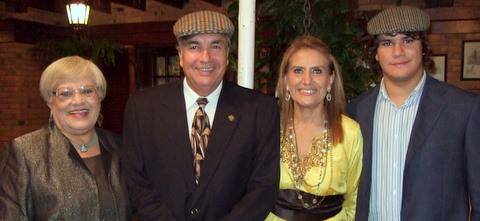
DSCF1416.JPGHere are some fresh Austro-Paraguayan faces. There's Florence Wood, Rodrigo Wood, his wife Carmen and son Brian. Rodrigo is a most agreeable Para-Aussie. He invited me to a special annual event hosted by Las Damas de Britanicas. A special curry dinner was cooked for nearly two hundred guests to celebrate those of Anglo-Saxon descent. While there were many English looking faces, certainly their energy on the dance floor seemed more towards the Latin end of the genetic spectrum. By the end of the evening Rodrigo was goading me to join him in some choruses of Waltzing Matilda.

I must say, it felt good to be Australian in this setting. Any sentimentalism about national identity back home (in Australia) seems too easily recruited to political or consumer interests. It's just too easily and ready-made. But on the other side of the world, deep in the heart of South America, Australianness seemed like an exotic flower. Could we even imagine a universal Australianness, appearing in all cultures, emerging with an innocent voice, blinking, happy to see things anew?

Tuesday, May 15, 2007

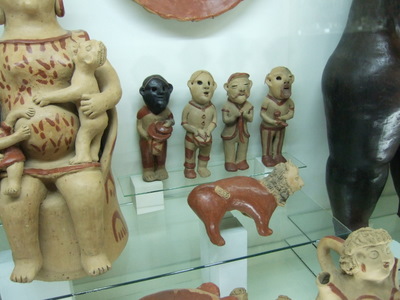
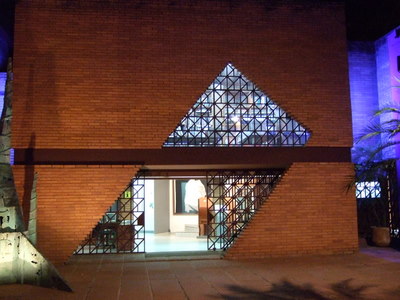
Museo del Barro (Museum of Mud) in Asunción, Paraguay

DSCF1244.jpg The Museo del Barro is a private museum originally established to show contemporary ceramic works from Paraguay. There had been a number of innovations with kilns that enabled more sculptoral works to develop, and the museum was seen as an imporant vehicle for this ceramic work to graduate from the street side sales in towns like Aregua, to a gallery context in the city
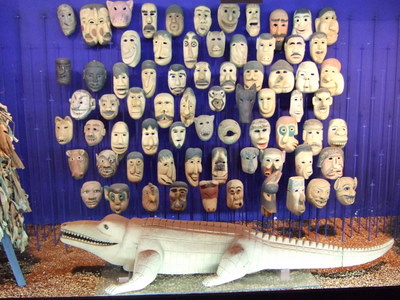
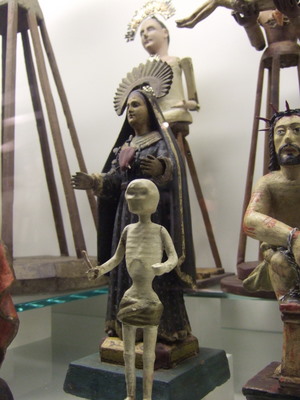
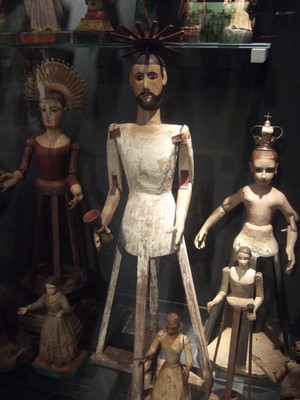
DSCF1220.jpg The institution was given a new life by a unique collaboration between three directors, Ticio Escobar (shown to the left), Carlos Columbino and Osvaldo Salerno. They brought together a collection that reflects the unique range of artistic life in Paraguay. This starts with the Hispanic Guarani Baroque originating in the Jesuit missions of the 16th-19th century. The marionette-like figures are designed to be dressed with real clothes. There are strong popular traditions, such as the masks donnned during the fiestas, and rediscovered ritual arts from the different Guarani tribes. A rather conservative craft tradition had led to highly intricate forms, such as the Nanduti, or 'spider web' needlework. Alongside this is a contemporary visual art that has responded strongly to the years of repression under the dictatorship of Stroessner.
DSCF1305.jpg The museum installation is quite beautiful, not just because of the well constructed display cases and lighting, but the way different traditional and modern is mixed together. Contemporary popular versions of saints are combined with quite dramatic figures dating back to the 16th century.
DSCF1297.jpgContemporary exhibitions of popular and contemporary art are shown in rooms adjacent to historical displays DSCF1269.jpgSome intricate work in Paraguayan lace, ñandutí..

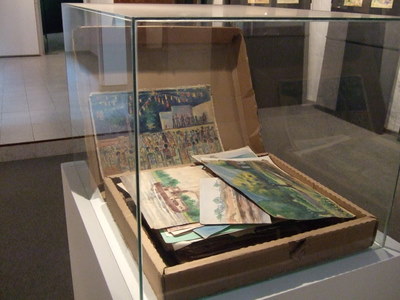
DSCF1230.jpgSome popular landscapes in watercolour

DSCF1343.jpg

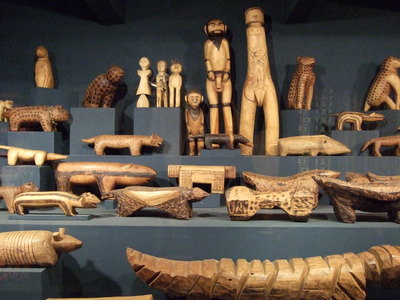
Guarani carvings.

DSCF1367.jpg
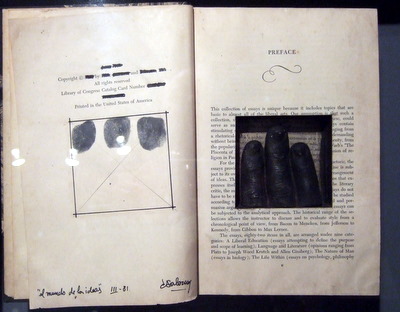
Quite uncanny words by Osvaldo Solerno.
DSCF1236.jpg
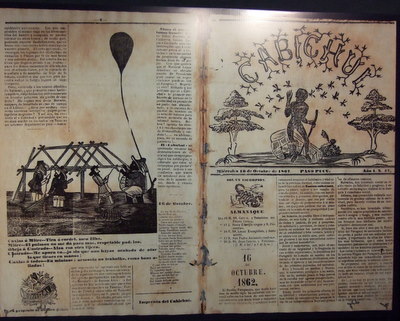
Cabichuí, a quite remarkable collection of cartoons depicting the War of the Triple Alliance, when Paraguay took on Argentina, Brazil and Uruguay.
DSCF1258.jpg

Some contemporary popular ceramics from the town of Tribatí.

DSCF1403.jpg

A shot from the interior courtyard.

Getting to Asunción is not easy, but it is worth it to visit Museo del Barro and then going on to encounter the living traditions on which it is based. Another example of the amazing rich treasury of southern cultures

Monday, May 14, 2007

The Leon Cadogan Foundation today

DSCF1459.jpg

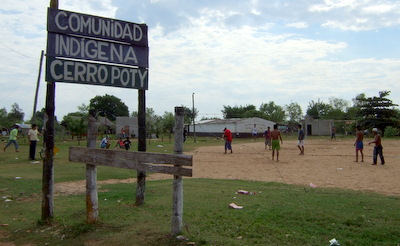
DSCF1460.jpg It was my great pleasure today to meet with Rogerio Cadogan, the son of the legendary León Cadogan who fought so hard for the rights of indigenous peoples in Paraguay, especially the Aché and the Mbya. Rogerio took me to a park where about 200 Aché had camped in preparation for a demonstration in front of parliament the next day. Next he took me to a community of Mbya camped near a tip quite close to the town of Asunción -- a place called Cerro Poty.

The León Cadogan Foundation is still working hard publishing various materials related to the preservation of indigenous cultures. They are now housed in the Centro Paraguayo de Estudios Sociales.

Sadly, none of León's work has been translated into English, despite his Australian ancestry. That is a project that certainly deserves attention. I tried to get a copy of his most influential complication, Ayvu Rapyta, the story of the Mbya people, but none of the bookshops I found had copies.

Sunday, May 13, 2007

Somewhere in Asunción, Paraguay


Paraguayans seem to enjoy feeling nationalistic. Here's a bit of street theatre happening down the main street in Asunsión on Friday night. Seven characters dressed in period costume from the time of the country's independence, though why they are each wearing bibs with the names of the week, I don't know. On asking various locals about this -- even an expert in street theatre -- no one seemed to have any idea who they were. That seems a typical story of Paraguay.

More strange and interesting by the hour.

Asunción, Paraguay 12 May 2007
Sunday Chance of Rain. Overcast. High: 22° C. Wind light. Chance of precipitation 40%.

Sunday, May 06, 2007

Getting to know the Latin neighbours

The article 'Getting to know the Latin neighbours' has been uploaded here.

Toubab tales

Here's a new term for non-indigenous, which I learnt from an article in Le Monde.

It's best explained in the website A Toubab Traveller's Tales:


A Toubab is the generic name for a white person in West and Central Africa ..
it is not a derogatory term of address and is more especially used in The Gambia and Senegal.

Depending on which you wish to believe .. the name Toubab has many suggested derivations, amongst which are: A corruption of the Arab word Tabib meaning doctor .. a verb in the Wolof language meaning 'to convert' (the early doctors and missionaries during colonial times, being whites coming from Europe) or the generally preferred .. that it is derived from the two bob (two shilling) coin of pre-decimalisation UK currency when The Gambia was a British Colony

Tabib (doctor) is similar in meaning to the Bantu umlungu (magician).

Saturday, May 05, 2007

Whiteness just isn't what it used to be

The ANC website has been running an interesting series of articles in a series 'White Identity in a Changing SA'. A core text in this analysis is Whiteness just isn't what is used to be.

The narratives in Steyn's book include:

  • Still colonial after all these years
  • This shouldn't happen to a white
  • Don't think white, it's alright
  • A whiter shade of white
  • Under African skies (or white, not quite)
  • Whiteness just ain't what it used to be

Here's a sample of the ANC discussion:

In the introduction of the book, Steyn notes this tendency - "of considerable resistance to talking about race as a social category" - represented, in part, by questions such as "Aren't we beyond this?"

Let us return to the strand, 'Whites are doing it for themselves', in the present narrative. "Perhaps," continues the insurance broker speculatively, "being white affected my life in a positive way, while being black affected many blacks negatively." The insurance broker concludes with the punch line: "White people tend to care more about their surroundings and keeping it clean than blacks do."

The familiar subtext - of a superior culture - underlying the previous narratives, infuses the 'Whites doing for themselves' strand of the 'Don't think white, It's all right' narrative.

Melissa E. Steyn Whiteness Just Isn't What It Used to Be: White Identity in a Changing South Africa (Albany: State University of New York Press, 2001) read

Sunday, April 22, 2007

The day I met an Australian

This week, it was my great pleasure to make the acquaintance of Reinaldo Mongelos, the new consul for Paraguay in Melbourne. Melbourne has around 45 Paraguayans, but there are many more in Sydney and around Griffith in NSW. Señor Mongelos is a builder and has been consul in an honorary capacity for many years. He is also an amateur ceramicist and a keen advocate of crafts, particularly from Guarani. With Señor Mongelos is Señor Christian Wood, a fourth generation Australian, descended from the original utopian settlers who came to Paraguay from Sydney in the late 19th century. Christian's grandfather Donald found in the horrible Chaco war against Bolivia. His father Alcides is a lawyer in Incarnación who tried to 'return' to Australia, but found that he missed Paraguay too much. Christian is following his father's footsteps and studying law at Melbourne University.