Showing posts with label Paraguay. Show all posts

Tuesday, June 19, 2007

Memo executives: try Paraguay, where the living is easy

From a recent report quoted in The Age about living expenses in different cities. Perhaps it is time to re-start a colony in Paraguay. 

And if you are an Australian and do not want to worry about high housing costs or expensive food, then maybe a few years in Asuncion, Paraguay, is the answer.

That is if your employer has an office in Asuncion, the world's cheapest city, and the capital of the landlocked South American country.

Memo executives: try Paraguay, where the living is easy 

Thursday, May 24, 2007

Out of the Woods

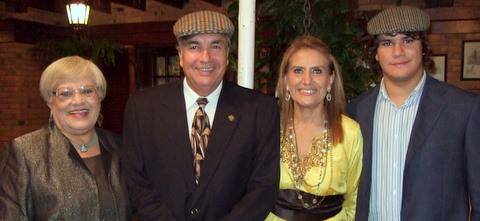
DSCF1416.JPGHere are some fresh Austro-Paraguayan faces. There's Florence Wood, Rodrigo Wood, his wife Carmen and son Brian. Rodrigo is a most agreeable Para-Aussie. He invited me to a special annual event hosted by Las Damas de Britanicas. A special curry dinner was cooked for nearly two hundred guests to celebrate those of Anglo-Saxon descent. While there were many English looking faces, certainly their energy on the dance floor seemed more towards the Latin end of the genetic spectrum. By the end of the evening Rodrigo was goading me to join him in some choruses of Waltzing Matilda.

I must say, it felt good to be Australian in this setting. Any sentimentalism about national identity back home (in Australia) seems too easily recruited to political or consumer interests. It's just too easily and ready-made. But on the other side of the world, deep in the heart of South America, Australianness seemed like an exotic flower. Could we even imagine a universal Australianness, appearing in all cultures, emerging with an innocent voice, blinking, happy to see things anew?

Tuesday, May 15, 2007

Museo del Barro (Museum of Mud) in Asunción, Paraguay

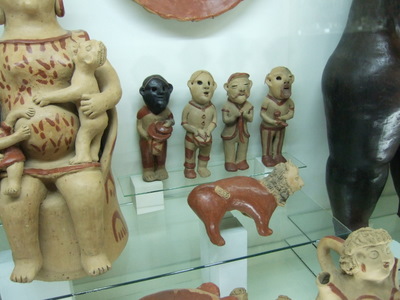
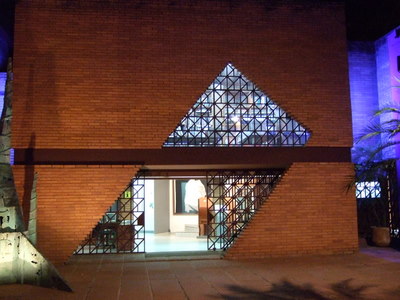
DSCF1244.jpg The Museo del Barro is a private museum originally established to show contemporary ceramic works from Paraguay. There had been a number of innovations with kilns that enabled more sculptoral works to develop, and the museum was seen as an imporant vehicle for this ceramic work to graduate from the street side sales in towns like Aregua, to a gallery context in the city
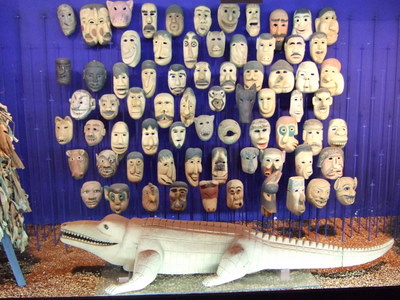
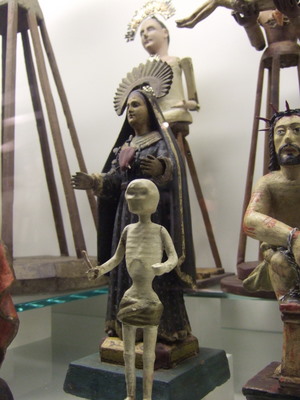
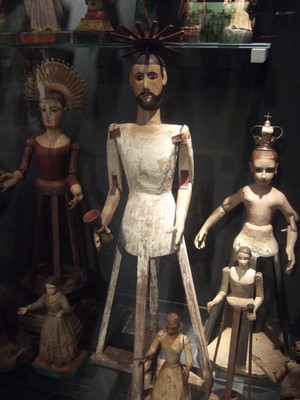
DSCF1220.jpg The institution was given a new life by a unique collaboration between three directors, Ticio Escobar (shown to the left), Carlos Columbino and Osvaldo Salerno. They brought together a collection that reflects the unique range of artistic life in Paraguay. This starts with the Hispanic Guarani Baroque originating in the Jesuit missions of the 16th-19th century. The marionette-like figures are designed to be dressed with real clothes. There are strong popular traditions, such as the masks donnned during the fiestas, and rediscovered ritual arts from the different Guarani tribes. A rather conservative craft tradition had led to highly intricate forms, such as the Nanduti, or 'spider web' needlework. Alongside this is a contemporary visual art that has responded strongly to the years of repression under the dictatorship of Stroessner.
DSCF1305.jpg The museum installation is quite beautiful, not just because of the well constructed display cases and lighting, but the way different traditional and modern is mixed together. Contemporary popular versions of saints are combined with quite dramatic figures dating back to the 16th century.
DSCF1297.jpgContemporary exhibitions of popular and contemporary art are shown in rooms adjacent to historical displays DSCF1269.jpgSome intricate work in Paraguayan lace, ñandutí..

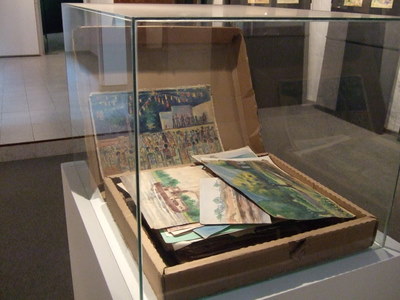
DSCF1230.jpgSome popular landscapes in watercolour

DSCF1343.jpg

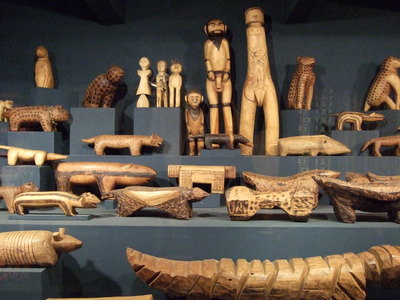
Guarani carvings.

DSCF1367.jpg
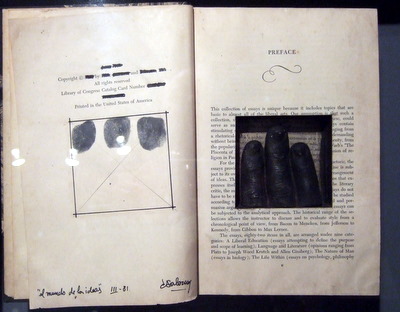
Quite uncanny words by Osvaldo Solerno.
DSCF1236.jpg
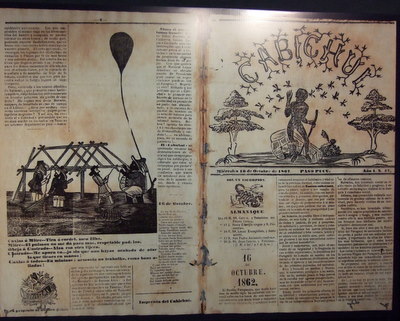
Cabichuí, a quite remarkable collection of cartoons depicting the War of the Triple Alliance, when Paraguay took on Argentina, Brazil and Uruguay.
DSCF1258.jpg

Some contemporary popular ceramics from the town of Tribatí.

DSCF1403.jpg

A shot from the interior courtyard.

Getting to Asunción is not easy, but it is worth it to visit Museo del Barro and then going on to encounter the living traditions on which it is based. Another example of the amazing rich treasury of southern cultures

Monday, May 14, 2007

The Leon Cadogan Foundation today

DSCF1459.jpg

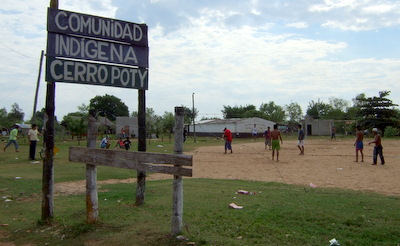
DSCF1460.jpg It was my great pleasure today to meet with Rogerio Cadogan, the son of the legendary León Cadogan who fought so hard for the rights of indigenous peoples in Paraguay, especially the Aché and the Mbya. Rogerio took me to a park where about 200 Aché had camped in preparation for a demonstration in front of parliament the next day. Next he took me to a community of Mbya camped near a tip quite close to the town of Asunción -- a place called Cerro Poty.

The León Cadogan Foundation is still working hard publishing various materials related to the preservation of indigenous cultures. They are now housed in the Centro Paraguayo de Estudios Sociales.

Sadly, none of León's work has been translated into English, despite his Australian ancestry. That is a project that certainly deserves attention. I tried to get a copy of his most influential complication, Ayvu Rapyta, the story of the Mbya people, but none of the bookshops I found had copies.

Sunday, May 13, 2007

Somewhere in Asunción, Paraguay


Paraguayans seem to enjoy feeling nationalistic. Here's a bit of street theatre happening down the main street in Asunsión on Friday night. Seven characters dressed in period costume from the time of the country's independence, though why they are each wearing bibs with the names of the week, I don't know. On asking various locals about this -- even an expert in street theatre -- no one seemed to have any idea who they were. That seems a typical story of Paraguay.

More strange and interesting by the hour.

Asunción, Paraguay 12 May 2007
Sunday Chance of Rain. Overcast. High: 22° C. Wind light. Chance of precipitation 40%.

Sunday, April 22, 2007

The day I met an Australian

This week, it was my great pleasure to make the acquaintance of Reinaldo Mongelos, the new consul for Paraguay in Melbourne. Melbourne has around 45 Paraguayans, but there are many more in Sydney and around Griffith in NSW. Señor Mongelos is a builder and has been consul in an honorary capacity for many years. He is also an amateur ceramicist and a keen advocate of crafts, particularly from Guarani. With Señor Mongelos is Señor Christian Wood, a fourth generation Australian, descended from the original utopian settlers who came to Paraguay from Sydney in the late 19th century. Christian's grandfather Donald found in the horrible Chaco war against Bolivia. His father Alcides is a lawyer in Incarnación who tried to 'return' to Australia, but found that he missed Paraguay too much. Christian is following his father's footsteps and studying law at Melbourne University.

Monday, March 12, 2007

Australians are hard to digest

John Gimlette's At The Tomb of The Inflatable Pig: Travels Through Paraguay is the most recent book on Paraguay that I have consumed. At first I thought it was sensationalist, but I am very impressed with this scholarship. The Paraguay that emerges from his book is a country that has been the subject of utopian fantasies from all corners of the earth -- usually with tragic results.

I learnt from this book about León Cadogan, descended from Australian settlers, who became an expert on Guaraní culture. Less appetising, was Gimlette's portait of Aussie descendents such as Bruce Murray, who seem unable to warm to the Latin ways. Even the Japanese proved more adaptable.

My encounter with Murray should not have troubled me as much as it did. Father Feehan had warned me: 'People here don't have the warmth of other Paraguayans. There is not that sense of belonging.' I thought about this as I made my way back through the square. It was planted with silky oaks, brought from Australia with the first settlers. There was a plaque to the villagers who'd perished in the war against Bolivia: Drakeford, Jones, King, Shepperson and Douglas Kennedy. Dying for Paraguay was, I supposed, only part of belonging to it. The Australians had obviously proved rather harder to digest than the Japanese.

John Gimlette At The Tomb of The Inflatable Pig: Travels Through Paraguay New York: Vintage, 2003, p. 228

Sunday, January 28, 2007

A tale of two utopias

This summer I've had the opportunity of learning about two seemingly contrary stories of collective aspiration. The Australian colony in Paraguay was a botched socialist project espousing equality of men, except for those who weren't white. On the other had, the freedom struggle in South Africa was an inspiring struggle for equality of men, which resulted in a workable nation state that provides a place for all colours.

DSCF0523.jpgThe leader William Lane combined his desire for worker's justice with a strong moral commitment to 'straightness', which included teetotalism and racial purity. It was interesting to read that after the failure of the colony in Paraguay, Lane went on to become editor of the New Zealand Herald, where he became a critic of unionism and advocate of imperialism, speaking often of 'We British...' There seem to be many reasons for the failure of the utopian quality, but a large measure of blame seems to lie with Lane whose self-pity left him unable to respond to the problems of others.

Gavin Souter writes about the racism in New Australia:

DSCF0521.jpg

'...the assumption that Anglo-Saxons were inherently superior to Hispano-Indians was as much a part of the colony's creed as teetotalism, a principle which had also been made explicit in the New Australia articles of association, but was now an unwritten law. The racial attitudes the colonists had brought with them from Australia were revealed by some of the facetious advertisements in Evening Notes: 'Boycott the Chinkie and save yourselves from the Yellow Agony by buying your vegetables from white gardener -- John Wilson'; 'Baxter's shoes - Nigger tickler clogs.'… this was not gracious, for on the whole Cosme fared well in its deadlings with the Government of Paraguay.'
Gavin Souter A Peculiar People: The Australians In Paraguay Sydney: Sydney University Press, 1968

DSCF0528.jpg

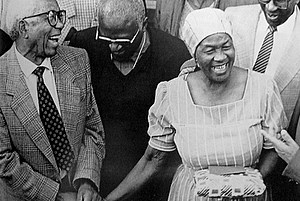
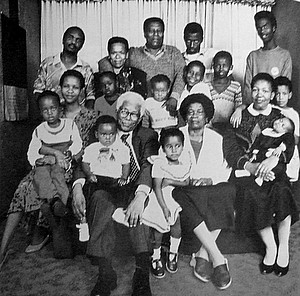
By contrast, the lives of Walter and Albertina Sisulu demonstrated enormous courage and fortitude. The scenes at the Rivonia trial in 1963 were extraordinary, as men like Walter and Mandela were getting ready to spend an indefinite period in Robben Island, and their wives Albertina and Winnie virtual widowhood. At the time, it seemed like the apartheid regime so lacked legitimacy that it was bound to crumble. To think that it would take another thirty years to finally end.

A recent book by their daughter-in-law Elinor artlessly balances dramas on the main political stage with the small domestic scenes that hold life togther. Here's an interesting practice that developed late in the struggle:

DSCF0526.jpg

'The Sisulu family observed a 'Black Christmas' at the end of 1985. This was the practice, began after the 1976 uprising, of eschewing the luxuries associated with Christmas and keeping expenditure to a bare minimum. Black South Africans felt that they had nothing to celebrate and saw no reason to swell the coffers of white-owned businesses. By 1985, there was almost a total observation of 'Black Christmas' in black communities around the country. Some white also observed this practice…'
Elinor Sisulu Walter & Albertina Sisulu: In Our Lifetime London: Abacus, 2003 (orig. 2002), p. 430


I realise that this kind of comparison is in danger of being judged an expression of self-loathing typical of liberal elite in Australia. Rather than settling into a fixed position about Australia as a 'white fortress', I prefer to see its history as a challenge for the future. Lane's experiment provides us today with the challenge of establishing a relationship with the Guaraní that he disregarded. It was interesting to meet with Ticio Escobar, the director of Paraguay's Museo del Barro (Museum of Mud), which houses work of the Hispanic-Guaraní Baroque. He had never heard of Nuevo Australia. Here perhaps is an opportunity to restore the conversation, and bring something of the Paraguayan culture to Australia.

The example of South Africa shows that 'our roots aren't our leaves'. The failures of the past point us to the potential successes of the future.

Saturday, January 06, 2007

Land-Without-Evil

I've just finished Hélène Clastres The Land-Without-Evil (trans. Jacqueline Grenez Brovender) Urbana: University of Illinois Press, 1995 (orig. 1975). As an account of the Guaraní and Tupí cultures, it seems very conceptual, reflecting the Parisian critique of commodification. But there are many very interesting asides that suggest alternative narratives for first contact. It appears that the Guaraní have a belief in the Land-Without-Evil (yvy marä ey), which is a distant place to the east, across vast waters, where humans can achieve immortality. Their history has been marked by prophets (karai) who have led tribes to find this land, always with disastrous consequences. When they encountered Jesuit priests, they found in the Christian story of the hereafter a version of their own utopianism, but kept a convenient distance from this world. They adopted these priests as their new prophets. Well, that's one story.

Monday, January 01, 2007

Being Paraguayan

I'm reading a few books about the Guaraní in Paraguay. Barbara Ganson's The Guaraní Under Spanish Rule In The Río De La Plata (Stanford, Ca.: Stanford University Press, 2003) is a plainly written book. The subject is fascinating, but her narrative fails to inspire. I am particularly interested in tracing the exchanges between the Jesuits and Guaraní that led to mutual cultural influence. Ganson is mostly dependent on written records, so she tends to extrapolate from the official dialogue of the time (including some canny if quite obsequious Guaraní letters to Spanish rulers). What interests me particularly is the Hispanic-Guaraní Baroque that developed in the Jesuit missions during the 17c and 18c. What frames all this is on stunning contemporary fact about Paraguay:
According to the 1992 census, 49 percent of the population of Paraguay spoke Guaraní and Spanish, 39.3 percent were monolingual Guaraní speakers, and 6.4 percent spoke only Spanish… Paraguay has the distinction of being the only country in the Western hemisphere where a native language is more widely spoken than a European one…. Today, less than 1-3 percent of the population in Paraguay is considered 'Indian'. (Ganson, 2003, p.185)
Imagine that in Australia. With roughly similar proportion of indigenous people in our population, yet was all spoke Aboriginal languages. Perhaps the 'tyranny of distance' was not that we were too far away from Europe, but not isolated enough. More to follow.