Monday, May 14, 2007

The Leon Cadogan Foundation today

DSCF1459.jpg

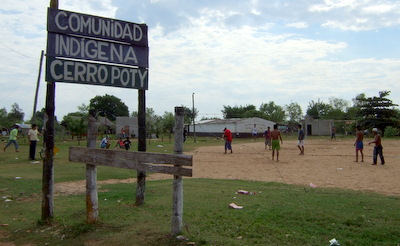
DSCF1460.jpg It was my great pleasure today to meet with Rogerio Cadogan, the son of the legendary León Cadogan who fought so hard for the rights of indigenous peoples in Paraguay, especially the Aché and the Mbya. Rogerio took me to a park where about 200 Aché had camped in preparation for a demonstration in front of parliament the next day. Next he took me to a community of Mbya camped near a tip quite close to the town of Asunción -- a place called Cerro Poty.

The León Cadogan Foundation is still working hard publishing various materials related to the preservation of indigenous cultures. They are now housed in the Centro Paraguayo de Estudios Sociales.

Sadly, none of León's work has been translated into English, despite his Australian ancestry. That is a project that certainly deserves attention. I tried to get a copy of his most influential complication, Ayvu Rapyta, the story of the Mbya people, but none of the bookshops I found had copies.

Sunday, May 13, 2007

Somewhere in Asunción, Paraguay


Paraguayans seem to enjoy feeling nationalistic. Here's a bit of street theatre happening down the main street in Asunsión on Friday night. Seven characters dressed in period costume from the time of the country's independence, though why they are each wearing bibs with the names of the week, I don't know. On asking various locals about this -- even an expert in street theatre -- no one seemed to have any idea who they were. That seems a typical story of Paraguay.

More strange and interesting by the hour.

Asunción, Paraguay 12 May 2007
Sunday Chance of Rain. Overcast. High: 22° C. Wind light. Chance of precipitation 40%.

Sunday, May 06, 2007

Getting to know the Latin neighbours

The article 'Getting to know the Latin neighbours' has been uploaded here.

Toubab tales

Here's a new term for non-indigenous, which I learnt from an article in Le Monde.

It's best explained in the website A Toubab Traveller's Tales:


A Toubab is the generic name for a white person in West and Central Africa ..
it is not a derogatory term of address and is more especially used in The Gambia and Senegal.

Depending on which you wish to believe .. the name Toubab has many suggested derivations, amongst which are: A corruption of the Arab word Tabib meaning doctor .. a verb in the Wolof language meaning 'to convert' (the early doctors and missionaries during colonial times, being whites coming from Europe) or the generally preferred .. that it is derived from the two bob (two shilling) coin of pre-decimalisation UK currency when The Gambia was a British Colony

Tabib (doctor) is similar in meaning to the Bantu umlungu (magician).

Saturday, May 05, 2007

Whiteness just isn't what it used to be

The ANC website has been running an interesting series of articles in a series 'White Identity in a Changing SA'. A core text in this analysis is Whiteness just isn't what is used to be.

The narratives in Steyn's book include:

  • Still colonial after all these years
  • This shouldn't happen to a white
  • Don't think white, it's alright
  • A whiter shade of white
  • Under African skies (or white, not quite)
  • Whiteness just ain't what it used to be

Here's a sample of the ANC discussion:

In the introduction of the book, Steyn notes this tendency - "of considerable resistance to talking about race as a social category" - represented, in part, by questions such as "Aren't we beyond this?"

Let us return to the strand, 'Whites are doing it for themselves', in the present narrative. "Perhaps," continues the insurance broker speculatively, "being white affected my life in a positive way, while being black affected many blacks negatively." The insurance broker concludes with the punch line: "White people tend to care more about their surroundings and keeping it clean than blacks do."

The familiar subtext - of a superior culture - underlying the previous narratives, infuses the 'Whites doing for themselves' strand of the 'Don't think white, It's all right' narrative.

Melissa E. Steyn Whiteness Just Isn't What It Used to Be: White Identity in a Changing South Africa (Albany: State University of New York Press, 2001) read

Sunday, April 22, 2007

The day I met an Australian

This week, it was my great pleasure to make the acquaintance of Reinaldo Mongelos, the new consul for Paraguay in Melbourne. Melbourne has around 45 Paraguayans, but there are many more in Sydney and around Griffith in NSW. Señor Mongelos is a builder and has been consul in an honorary capacity for many years. He is also an amateur ceramicist and a keen advocate of crafts, particularly from Guarani. With Señor Mongelos is Señor Christian Wood, a fourth generation Australian, descended from the original utopian settlers who came to Paraguay from Sydney in the late 19th century. Christian's grandfather Donald found in the horrible Chaco war against Bolivia. His father Alcides is a lawyer in Incarnación who tried to 'return' to Australia, but found that he missed Paraguay too much. Christian is following his father's footsteps and studying law at Melbourne University.

Thursday, March 29, 2007

What if?

I recently reviewed the volume What if: Australia as it Might have Been for ABC Radio National Book Show. You can find the 'full' transcript, here.

Monday, March 12, 2007

Australians are hard to digest

John Gimlette's At The Tomb of The Inflatable Pig: Travels Through Paraguay is the most recent book on Paraguay that I have consumed. At first I thought it was sensationalist, but I am very impressed with this scholarship. The Paraguay that emerges from his book is a country that has been the subject of utopian fantasies from all corners of the earth -- usually with tragic results.

I learnt from this book about León Cadogan, descended from Australian settlers, who became an expert on Guaraní culture. Less appetising, was Gimlette's portait of Aussie descendents such as Bruce Murray, who seem unable to warm to the Latin ways. Even the Japanese proved more adaptable.

My encounter with Murray should not have troubled me as much as it did. Father Feehan had warned me: 'People here don't have the warmth of other Paraguayans. There is not that sense of belonging.' I thought about this as I made my way back through the square. It was planted with silky oaks, brought from Australia with the first settlers. There was a plaque to the villagers who'd perished in the war against Bolivia: Drakeford, Jones, King, Shepperson and Douglas Kennedy. Dying for Paraguay was, I supposed, only part of belonging to it. The Australians had obviously proved rather harder to digest than the Japanese.

John Gimlette At The Tomb of The Inflatable Pig: Travels Through Paraguay New York: Vintage, 2003, p. 228

Monday, February 05, 2007

A Black week

This has not been a good week for tolerance. Not that there has been any overt violence against others, like in the Cronulla riots, but that material has been gathered to make it more difficult for people who are different from the mainstream, particularly in colour.

The Sudanese man Hakeem Hakeem was sentenced to 24 years this week for serious offences against three women. This has prompted the Federal government minister Kevin Andrews to consider limiting intake from the Horn of Africa. I was in the court when Hakeem was sentenced and met his father, who attends the same Catholic Church as my father. Hakeem's crimes do seem heinious and inexcusable, but he has a punishment to fit that. With the little I know of the family, I can merely guess what a shock it is to move from the chaos of civil war in Sudan to the eerily quiet security of Melbourne. You would hope that as a community we could see their problems as our problems, rather than an alien infiltration.

Then there was the Geoff Clark case. And last night I saw Fox Studios Last King of Africa, which reinforces every prejudice you might have about black African men. It's not that it is inaccurate in its portrayal about Idi Amin, but that it leaves with the audience with virtually no knowledge of the culture of Uganda, it only confirms the suspicion that white people have to be wary of their black neighbours.

A saving grace was finishing the novel by André Brink, which tells the story of a Khoi San man who converts and tries to become a missionary. His mentor, the Reverend James Reed, writes about the experience of coming to grips with Africa:

How old and remote Europe seemed from here: old, and remote, and -- yes -- beautiful, but inexorably sinking, drowning, fading into futility and pastness. Where here, in the midst of these sounds of menace and violence and lurking death, here was something different, a timelessness, an awareness of futurity, a still untamed, unpredictable, savage energy, a passion unquenched and unquenchable, a force that might destroy people and lives, but which was life itself, a physical reality, a closeness, an urgency, a rare and unspeakable presence of wonderment and joy.
André Brink Praying Mantis London: Secker & Warburg, 2005, p. 140

Yes, let's not forget the 'wonderment and joy'...

Sunday, January 28, 2007

A tale of two utopias

This summer I've had the opportunity of learning about two seemingly contrary stories of collective aspiration. The Australian colony in Paraguay was a botched socialist project espousing equality of men, except for those who weren't white. On the other had, the freedom struggle in South Africa was an inspiring struggle for equality of men, which resulted in a workable nation state that provides a place for all colours.

DSCF0523.jpgThe leader William Lane combined his desire for worker's justice with a strong moral commitment to 'straightness', which included teetotalism and racial purity. It was interesting to read that after the failure of the colony in Paraguay, Lane went on to become editor of the New Zealand Herald, where he became a critic of unionism and advocate of imperialism, speaking often of 'We British...' There seem to be many reasons for the failure of the utopian quality, but a large measure of blame seems to lie with Lane whose self-pity left him unable to respond to the problems of others.

Gavin Souter writes about the racism in New Australia:

DSCF0521.jpg

'...the assumption that Anglo-Saxons were inherently superior to Hispano-Indians was as much a part of the colony's creed as teetotalism, a principle which had also been made explicit in the New Australia articles of association, but was now an unwritten law. The racial attitudes the colonists had brought with them from Australia were revealed by some of the facetious advertisements in Evening Notes: 'Boycott the Chinkie and save yourselves from the Yellow Agony by buying your vegetables from white gardener -- John Wilson'; 'Baxter's shoes - Nigger tickler clogs.'… this was not gracious, for on the whole Cosme fared well in its deadlings with the Government of Paraguay.'
Gavin Souter A Peculiar People: The Australians In Paraguay Sydney: Sydney University Press, 1968

DSCF0528.jpg

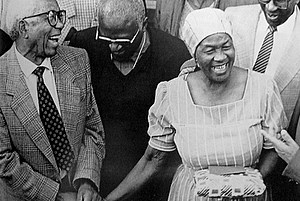
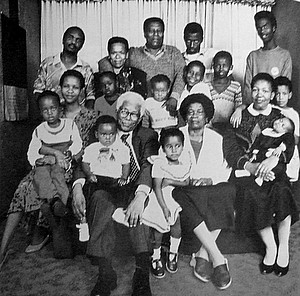
By contrast, the lives of Walter and Albertina Sisulu demonstrated enormous courage and fortitude. The scenes at the Rivonia trial in 1963 were extraordinary, as men like Walter and Mandela were getting ready to spend an indefinite period in Robben Island, and their wives Albertina and Winnie virtual widowhood. At the time, it seemed like the apartheid regime so lacked legitimacy that it was bound to crumble. To think that it would take another thirty years to finally end.

A recent book by their daughter-in-law Elinor artlessly balances dramas on the main political stage with the small domestic scenes that hold life togther. Here's an interesting practice that developed late in the struggle:

DSCF0526.jpg

'The Sisulu family observed a 'Black Christmas' at the end of 1985. This was the practice, began after the 1976 uprising, of eschewing the luxuries associated with Christmas and keeping expenditure to a bare minimum. Black South Africans felt that they had nothing to celebrate and saw no reason to swell the coffers of white-owned businesses. By 1985, there was almost a total observation of 'Black Christmas' in black communities around the country. Some white also observed this practice…'
Elinor Sisulu Walter & Albertina Sisulu: In Our Lifetime London: Abacus, 2003 (orig. 2002), p. 430


I realise that this kind of comparison is in danger of being judged an expression of self-loathing typical of liberal elite in Australia. Rather than settling into a fixed position about Australia as a 'white fortress', I prefer to see its history as a challenge for the future. Lane's experiment provides us today with the challenge of establishing a relationship with the Guaraní that he disregarded. It was interesting to meet with Ticio Escobar, the director of Paraguay's Museo del Barro (Museum of Mud), which houses work of the Hispanic-Guaraní Baroque. He had never heard of Nuevo Australia. Here perhaps is an opportunity to restore the conversation, and bring something of the Paraguayan culture to Australia.

The example of South Africa shows that 'our roots aren't our leaves'. The failures of the past point us to the potential successes of the future.

Friday, January 26, 2007

Eat the Bustard!

An article in New Matilda argues that Australians are missing the opportunity to use its own resources -- choosing to farm the American turkey and chicken rather than its own indigenous bustard.

Given the palatability of the bird, why did Australians begin to lose interest in bustards and refocus instead on importing American turkeys - yet another introduced species that could potentially harm Australia? Why didn't they build an industry around sustainably harvesting, and in the process conserving, a valued Australian bird? Our guess is that native foods were increasingly seen as 'poor man's tucker' and as such were gradually removed from Australian cookbooks.
The contrast between the current status of the bustard and the chicken in Australia is stark: the former is struggling to survive and in decline, the latter is the continent's most numerous bird. Indeed, the chicken is now thought to be the world's most numerous bird, all eight billion of them.

Bob Beale and Michael Archer are co-authors of Going Native: Living in the Australian Environment (Hodder Headline)
Bob Beale and Michael Archer 'Sustainability: Eat the Bustard!' New Matilda www.newmatilda.com/home/articledetail.asp?ArticleID=1932&CategoryID (22/11/2006)

Wednesday, January 10, 2007

Pommie Balandas

An article in the UK Telegraph by Richard Madden promotes the Gama Festival for English tourists. He positions it as an event for Balanda:

Garma is Australia's leading cultural exchange event, attended by about 1,200 tribal members from 20 clan groups of the local Yolngu people and about 800 Balanda - non-aboriginal "white fellas" like me.

In particular, he praises the festival as an experience of reconciliation. Yunupingu's position seems similar to the South African value of Ubuntu.

"We will walk side by side with each other, even with our worst enemy," Mandawuy Yunupingu had proclaimed on the first morning of Garma. Five days later, on the final night, as I watched him lead his band Yothu Yindi in front of an ecstatic crowd, it was hard not to become wrapped up in the spirit of optimism and reconciliation that Garma creates.

Sunday, January 07, 2007

Euraustralians Unite

A recently replayed program on ABC Radio National features Xavier Herbert's letter to his publisher 'Inky' Stephenson, when he argues for the rights of the 'Euraustralians', those non-indigenous or half-breed settlers who cannot be called 'real Australians' because they lack Aboriginal identity, but belong here more than the 'pommies'. Hindsight - 24 September 2006 - In Capricornia Country: the Legend of Xavier Herbert

Saturday, January 06, 2007

Land-Without-Evil

I've just finished Hélène Clastres The Land-Without-Evil (trans. Jacqueline Grenez Brovender) Urbana: University of Illinois Press, 1995 (orig. 1975). As an account of the Guaraní and Tupí cultures, it seems very conceptual, reflecting the Parisian critique of commodification. But there are many very interesting asides that suggest alternative narratives for first contact. It appears that the Guaraní have a belief in the Land-Without-Evil (yvy marä ey), which is a distant place to the east, across vast waters, where humans can achieve immortality. Their history has been marked by prophets (karai) who have led tribes to find this land, always with disastrous consequences. When they encountered Jesuit priests, they found in the Christian story of the hereafter a version of their own utopianism, but kept a convenient distance from this world. They adopted these priests as their new prophets. Well, that's one story.

Monday, January 01, 2007

Being Paraguayan

I'm reading a few books about the Guaraní in Paraguay. Barbara Ganson's The Guaraní Under Spanish Rule In The Río De La Plata (Stanford, Ca.: Stanford University Press, 2003) is a plainly written book. The subject is fascinating, but her narrative fails to inspire. I am particularly interested in tracing the exchanges between the Jesuits and Guaraní that led to mutual cultural influence. Ganson is mostly dependent on written records, so she tends to extrapolate from the official dialogue of the time (including some canny if quite obsequious Guaraní letters to Spanish rulers). What interests me particularly is the Hispanic-Guaraní Baroque that developed in the Jesuit missions during the 17c and 18c. What frames all this is on stunning contemporary fact about Paraguay:
According to the 1992 census, 49 percent of the population of Paraguay spoke Guaraní and Spanish, 39.3 percent were monolingual Guaraní speakers, and 6.4 percent spoke only Spanish… Paraguay has the distinction of being the only country in the Western hemisphere where a native language is more widely spoken than a European one…. Today, less than 1-3 percent of the population in Paraguay is considered 'Indian'. (Ganson, 2003, p.185)
Imagine that in Australia. With roughly similar proportion of indigenous people in our population, yet was all spoke Aboriginal languages. Perhaps the 'tyranny of distance' was not that we were too far away from Europe, but not isolated enough. More to follow.

Sunday, November 26, 2006

Catch an interesting film

Given the celebration of Rabbit Proof Fence, it seems strange that Philip Noyce's follow up film Catch a Fire seems to have such a low profile. The film is particularly interesting for the portrayal of Nik Vos by Tim Robbins. In one scene, the Boer anti-terrorist expert is shown singing a gentle folk song accompanied by guitar with his young family. The film touches on the anxiety that formed the base to Apartheid, as well as the demoralising effects this had on its victims.

In an inteview for Emanuel Levy, Noyce admits a particular resonance as an Australian working on a film set in South Africa.

 For Noyce, the most challenging part of making Catch a Fire was “being a white Australian tackling a South African story that deals with so many events of historical significance to that country. I very quickly began immersing myself in South African culture and history.

And reflecting on his experiences in researching white South Africans:

Talking to those police officers as I did — to many of them, ex-police officers in South Africa — I realized that they all saw themselves as Africans. That was a strange concept to me: How could a white person think of himself as African? And yet many of them lay claim to 300 years or more of continued residency in southern Africa. Some of them said, "Well, I've been here longer than Patrick Chamusso, than his forefathers. I'm African." Others said, "We were fighting a vicious, determined enemy, who was determined to destroy everything that we'd fought to build up here."

Elsewhere, he says...

the South Africans are a beacon to the rest of us; they are the light at the end of the tunnel that we never seem to see an end to - the tunnel of seemingly irresolvable differences between us all

Sunday, November 19, 2006

The lost world of Australia

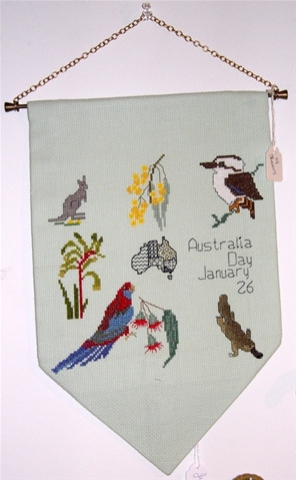
A recent exhibition Coathangers at Shepparton Art Gallery was a reminder of how distant contemporary Australian culture has come from the idioms of local flora and fauna that once were conventional symbols of national identity. The country crafts that feature gumnuts, kookaburras and platypuses (?) seem almost baroque now, in their distance from urban life. Not that there aren't animals in contemporary decorative arts, just that they are almost all European -- deers, owls, wolves and rabbits. The time is ripe for a radical move within the arts to use local flora and fauna for shock value.

Friday, November 10, 2006

Embrace the night

Imagine the City of Melbourne dedicating one night to darkness. Across the city, street lights are turned off and residents advised to extinguish their house lights. Cars stop. Residents venture onto the street and gaze up to the night sky. Parents explain to their children how the ancient Greeks saw mythological creatures in the sky. Adolescents turn off their phones and see where the Southern Cross is. A magic at hand...

Authorities in the capital Reykjavik will turn off street lights on Thursday evening and people are also being encouraged to sit in their houses in the dark, writer Andri Snaer Magnason said on Wednesday. While the lights are out, an astronomer will describe the night sky over national radio.

http://www.aftenposten.no/english/world/article1474652.ece

Tuesday, October 24, 2006

On the road to elsewhere

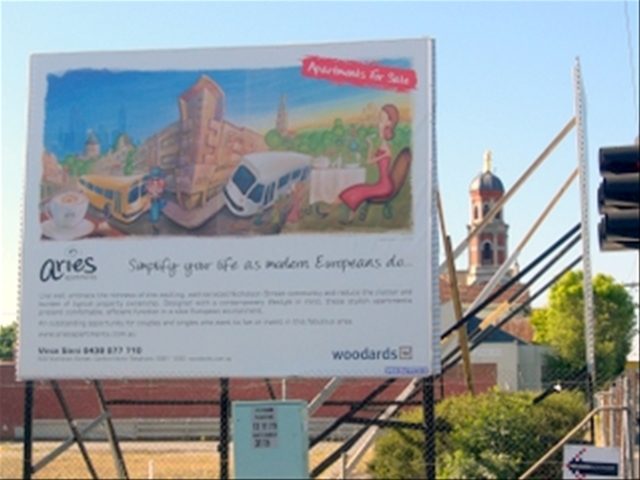
This advertisement sits on the corner of Holden and Nicholson Street, Brunswick, Melbourne. It reads:

Simplify your life as Europeans do... Live well, embrace the richness of the exciting, well-serviced Nicholson Street community and reduce the clutter and burden of typical property ownership. Designed with a contemporary lifestyle in mind, these stylish apartments present comfortable, efficient function in a slick European environment. An oustanding opportunity for couples and singles who want to live or invest in this fabulous area.

An interesting exchange this. While it directs our gaze upwards, to the 'slick' and  'stylish' European manner, it actually resigns us to reduced living space.  While higher density might be desirable, is there a way of selling this without having us pretend that we are living at the opposite end of the planet?

Friday, October 20, 2006

Multiculturalism at large in Brunswick

A reliable source informs me of the following scene at a Lebanese restaurant in Brunswick. Tiba's is a notoriously good place to eat, especially during Ramadan, where the food is always fresh and full of flavour. Despite their non-alcohol policy, they attract many non-Muslims from the neighbourhood.

Last night, apparently, a group entered which included a Jewish couple (man in yamulkah and woman in wig) together with a couple of young Muslim woman. They were overheard talking about 'our Jewish brothers and sisters'.

There are growing signs of creeping multiculturalism in our midst. What's happened to the fear and distrust that we have come to rely on?

What will be next? Sorry?