Tuesday, March 05, 2013

Australia Then, Apocalypse Now

The resounding success of the Sapphires seems a significant moment in Australian culture. The film has not only been a popular hit with mainstream audiences, it has also received the top AACTA awards in the industry, winning best film, director and female actor. This energetic comic tale is seen as a ‘positive indigenous story’, by contrast to the hard truths of films such as Samson & Delilah. I certainly enjoyed the powerful Deborah Mailman, the enlivening Irish manager, the pumping soul music and even the inventive editing. As the writer Tony Briggs said, 'I wanted this film to be more about fun and entertainment than anything else'. Enough said?

But reality is hard to hide. The premise was about a group of Aboriginal singers going to Vietnam to entertain US troops. Despite the now conventional view that this war was a heroic struggle of independence by a small nation against a more powerful aggressor, The Sapphires sidesteps the moral context of the war. In terms of the narrative, the only issue at stake is the capacity to put on a good show for the invading army. The reality was quite different. In the real story, only two Sapphires went to Vietnam. The others stayed at home because they were part of the Australian anti-War movement. Why has this been deliberately overlooked in the film version?

As a comic film, it’s understandable that it uses simplifications in order to heighten emotions: all white Australians are prim racists and US popular culture promises liberation from prejudice. But the appeal of these stereotypes is limited to local audiences. The Sapphires had only a five week run in the UK, was called ‘le flop’ in France and received tepid US reviews. Why do Australian audiences enjoy this story so?

Maybe it's an essentially provincial story. It reflects an innocent and isolated settler colony nostalgic for the world once made familiar by a dominant Western power. This nostalgia emerges at a time of a quite profound political realignment of Indigenous and conservative voices.

Some Aboriginal voices now distance themselves from the liberal left. Marcia Langton’s Boyer Lectures have set the interests of the emerging Aboriginal middle class directly against the patronising southerners—‘leftists’—associated with the wilderness movement and social justice.

This divergence has been growing in recent times, in much less partisan ways, as Aboriginal interests engage with established power rather than be boxed into the radical margins. Figures like Tracey Moffatt embrace the global art scene in defiance of the perception that she should be earnestly depicting the plight of her people. Indigenous scholars such as Christian Thompson make the pilgrimage to Oxford. And in the academy, Indigenous Studies aspires to value of the sandstone university rather than identify with declining critical studies.

The trajectory of emancipation thus seems to lead away from the values of solidarity that set it in train. Isn't it the ultimate form of empowerment for an Aboriginal artist not to make work about Aboriginality? It's hard to question this form of success. Besides, the days of a non-indigenous person questioning Aboriginal choices has long gone.

So where does this place the southerner, who once saw solidarity in defending indigenous culture against the ravages of historic colonialism and mainstream capitalism. Is this just another sign of the liberal left’s growing irrelevance? Just as Western Sydney has deserted the ALP, and developing nations go for economic growth before environmental sustainability, are the ideals of the educated classes revealed as self-absorbed fantasies, designed more for ideological fashions than real action? Like Graham Greene’s deluded romantic heroes, are the champions of global change now lost in the real world of nations, each scrambling over each other to climb the ladder?

What do you say to someone from a 'developing' nation who baulks at energy limits, saying why should we have to pay for your mistakes? Why shouldn't we enjoy the same privileges as you take for granted?

Certainly, one path is to accept the seeming inevitable. I remember talking a white academic in South Africa about the fellow travellers who has been part of the freedom struggle, yet were completely ignored by the incoming ANC government. Those at odds with the government, like Coetzee, were seen as unable to accept that collective victory may come at a personal cost. It seemed an important part of the story of solidarity that even its heroes had to learn to step aside so that black empowerment could develop. As the professor said, ‘It’s what we all fought for after all.’

But while resentment should be avoided, does it follow that the original ideals must also be abandoned? To do so implies that the values originally espoused were dependent on validation from elsewhere—that ideals were upheld in the name of the other, not in their own right.

In the previous Arena, Boris Frankel wrote ‘Indigenous people can’t suddenly become mainstream and yet be exempted from the same obligations of non-Indigenous people to prevent dangerous climate change.’ Yes, but rather than couch this in moralistic terms, it seems more appropriate to place the onus on the settler position: non-indigenous should not lower their expectations of ethics dependent on indigeneity. Despite acknowledging the individual benefits of working in the mining industry, we should still expect Marcia Langton to mention the greater challenge of climate change.

There are significant Aboriginal voices that seek to articulate a common good. Christine Black's book of indigenous legal theory, The Land is the Source of the Law, offers a particularly strong Aboriginal context for environmental concerns in the thinking of Senior Law Men.

Across the Pacific, the buen vivir movement in Bolivia and Ecuador shows how a successful indigenous movement can emerge and still contest the mainstream. Even if such values do seem increasingly marginal, particularly with a three-term Liberal national government looming, they shouldn’t be abandoned. The historical commitment of Aboriginal leaders and communities to maintain an Indigenous culture, despite its status as ‘backward’, should be the very example that inspires an ethical stance today.

Marcia Langton’s Boyer lectures are a wakeup call. Arena demonstrates its relevance by offering a rare forum for debate on this issue, aided now by the Project Space which showed the paintings by Garawa man, Jacky Green, testifying to the destruction of sacred land by mining.

However, from Langton’s position, we ‘leftists’ reading Arena are in danger of being seen as just like those prim white Shepparton settlers in The Sapphires. Perhaps we are more likely to be cast in this role by rejecting mining outright, despite its obvious benefits for a large community of Australians. Sure, the obese extractocrats make it easy to pillory these ventures. But should Langton be the only outside interest at their table? Without being beholden to the mining industry for research funding, it should be possible to advocate for environmentally responsible practices.

So while it’s possible to enjoy the Sapphires, it’s also reasonable to feel that this leaves a story untold. Good morning Vietnam, g'day Ho Chi Minh City.

Thanks to Christine Black, Deborah Jordon, Damien Wright and Esther Lowe for feedback.  A better version may end up in Arena Magazine.

Monday, April 12, 2010

Being Watjala

3518522464_e675d8d5ac[1]

While I live today as a Gubba, in Koorie land, and my most intense contact with Indigenous Australia has been as a Balanda, up north, I am originally a Watjala, a whitefella from Perth.

As a suburban boy, my contact with the world of Noongahs was largely speculative. In our neighbourhood, the roof of a bottle shop was adorned with a ‘Jackie’ sculpture of bearded aboriginal man with spear resting his foot on his knee. His silhouette defined our eastern sky. But the figure had as much to do with my childhood world as a Masonic Lodge.

But since I’ve been coming back to WA, I’ve gradually become more acquainted with the Noongah world. Through Nalda Searles I was able to meet the spirited women artists down south-west, in Narrogin, who made us Seven Sisters dolls.

Back for another visit last week, I became much more aware of the Noongah presence in the city of Perth. On Friday night, I was walking up Barrack Street behind a lithe young man with a beat box on his shoulder playing disco music. I was really admiring his footwork, a mixture of Travolta and traditional dance. I felt in touch with Perth as a city, with the energy of its different people’s gathered together.

But it was short-lived. Six policemen came out of nowhere and surrounded the young man. Compared to the dancer, these men were ox-like. One of them got out the blue plastic gloves and they started interrogating him.

Dennis at first tried to be cheeky with them. He was a little out of it, but sharp. The moustached officer who was leading the group maintained a completely impassive face. Eventually, Dennis succumbed and took a submissive position, calling him ‘boss’. I heard them talking about something that had been picked up on a city security camera.

Pedestrians walked around the scene with as much impassiveness as the policeman. But I stood still, about five metres from the group, and kept my gaze fixed at the policeman. He turned to me and asked, ‘You got any questions’. I shook my head but stayed. I was curious to see what happened, but also wanted to be some kind of witness, at least to have some acknowledgment of what was happening.

Eventually, Dennis started being cheeky again. I think he was just getting restless. The policeman’s face seemed to soften. He was a long way from smiling, but it seemed a little more relaxed. They eventually let Dennis go.

I walked away with Dennis and told him I liked the way he danced. He laughed at me and asked for $3. We turned the corner and ran into a small group of Noongah men and women staggering around. They were talking about booze and glue. Dennis bumped into a young woman and she asked him if he wanted a ‘push’.

I doubt the police would admit to being racist. But they don’t need to be. There are racists enough in Perth, eager to get the baseball bat out on a drunken Noongah lad. The police are there just to clean up the mess, and make sure the semblance of public order is maintained.

That Dennis could really dance.

Friday, October 16, 2009

The role of black face

There's been an outrage about an act involving Black Face in a revived television show Darryl Somers. Australians are seen as being backward and insensitive about the way comedy can ridicule people of different colour. It certainly doesn't place Australia in a great light to be seen as living in this neverland of the Deep South. But I do wonder whether there is potentially a worthwhile purpose in black face. I'm thinking particularly of its version in Cape Town, where people under apartheid known as Coloured were inspired by the American minstrels to create their own version of black face. There's something about this form that acknowledges inauthenticity while engaging with difference. I'd be hopeful that there's a way in which black face can help Australians engage with the difference between non-indigenous and indigenous. We've already seen with the Chooky dancers how effective 'white face' can be. If this was loosened up and there be a testing experimental attitude to it, it would help us come to terms with the essential inauthenticity of white existence in this country, where the best option might be to find ways of assimilating into indigenous culture, but in a way that acknowledges its secondary nature.

Tuesday, June 02, 2009

The mighty Murtoa stick shed

Many year ago, when I was working for Museums Australia, I wrote about one of the wonders of Victoria, the Murtoa Stick Shed.

I was very pleased to see recently that Leigh Hammerton has hoisted a website in honour of this ‘found cathedral’. Let’s hope it helps gain a new life as a cultural centre of the Wimmera.

Friday, February 20, 2009

Help Nombeko leap over to Australia

From Pam Zeplin comes the following request:

Nombeko Rwaxa was one of the B&B hosts for the 2007 South Project Gathering in Soweto. She was an integral part of the supportive local community in Orlando, Soweto that made this event so successful.

Nombeko has also been professionally associated with the music world with figures such as the late Lucky Dube. She received a kidney transplant not long ago and successfully competed in the National Transplant Games in South Africa. This has qualified Nombeko to come to Australia and compete in the World Transplant Games at the Gold Coast  (Queensland) (August 22-30 2009), under the auspices of South African Transplant Sports Association (see attached letters and website www.transplantsports.org.za .

This association and its athletes are seeking sponsorship to attend these games. Individual as well as corporate sponsorship can be accepted. As a previous guest at her Zizwe Guesthouse in Orlando, Soweto Nombeko has asked me to help find sponsors for this life affirming project.

For further information Willie Uys, National Chairman, South African Transplant Sports Association (E-mail: info@transplantsports.org.za )

Wednesday, February 11, 2009

Getting to know wortabokarra

There are several days in summer when Melbourne is whipped by scorching northerly winds. They come in across the great deserts of the centre and bake this southerly city. They often bring with them the top soil of the Wimmera, and sometimes even ash from nearby bushfires.

Despite living with the curse – and dread – of this wind, we haven’t yet given it a name. While one-off cyclones are personified, this regular visitor remains anonymous. It’s as thought we haven’t yet settled into the land enough yet to have developed the acquaintance.

In Crikey, an Adelaide vertebrate palaeontologist Jim McNamara nominates the Kaurna word wortabokarra:

In 1840, Teichelmann and Schurmann, recorded its meaning as: "north-west wind; tempestuous weather". They also have bokarra: "northwesterly wind, which is very hot during summer and indicates a storm".

This is more like it.

What are the word's roots?

I am not a linguist, but the same book (available as a copy from Google) tells me that worta means "behind" and karra is the redgum tree with other meanings of high, sky and heaven.

Perhaps one response to the tragedy of Black Saturday would be a finally give this wind a name. If anything, it is likely to become a more regular visitor. It’s time we got onto speaking terms with it.

Sunday, February 08, 2009

Climate changed!

image

The day began with talk of gardens. We are moving into the post-Magnolia era. No longer can we ornament our homes with camellia-centric gardens, no more erect birch trees. It’s back to the natives.

In terms of the disaster, the Victorian bushfires and Melbourne’s inferno is relatively mild. Compared to the disasters that can strike other cities due to earthquakes, the lost of life was small. But there seemed something like a loss of innocence on this day. We can no longer pretend to be a piece of green Europe tucked away in the antipodes. Instead, we’re part of a big brown continent. We can’t escape the cruel logic of its weather.

It’s time to join Australia.

Wednesday, January 28, 2009

The heatwave we had to have

image

It was the week we had been dreading. After a comfortably mild December and early January, the inevitable heat wave was finally coming our way.

And it is going to be a killer. Five days straight of 40-degree heat. Perhaps it’s payment for the overdue hot days we missed so far. Plus the inexorable path of global warming. For a few cool days it seemed that all was pleasant in the world.

And then, on the first of the days, a gentle southerly breeze tempered the heat. Around midday, the temperature suddenly dropped and it seemed that perhaps we could escape the worst. Perhaps a butterfly sneezed in Beijing, and the high that has settled over Tasmania has quickly moved on.

But the northerlies eventually prevailed. If anything, the forecast now has got worst. It is going to be 43 degrees on Thursday.

After the collapse of Wall Street last year, the Australian government introduced a stimulus package to stave off recession. For a while, in December, it seemed that we would escape the worst. Extra dollars poured into shops for Christmas and there was plenty of fruit on the trees. It even rained.

And then there was the Obama inauguration, when the world seemed unified in a vision of hope. A passenger jet landed on the calm waters of the Hudson river. Obama started his mission ‘faithfully’. Jelena Dokic re-emerged from nowhere to win hearts at tennis.

But as the year rolls on, the newspapers are filled with more bad news and commentators are warning that with the downturn in China Australia will not escape economic hardship.

Things will get worse before they get better.

Last night Dokic lost.

It’s enough to make you a Stoic.

Saturday, January 10, 2009

Mandatory Europeanism

image

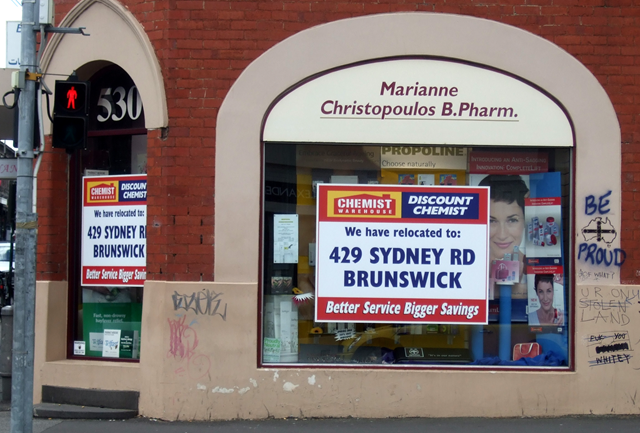
The chemist occupies a special place in a neighbourhood. The pharmacist claims a strangely intimate relation to the client. We entrust the man or woman in the white coat with the embarrassing details or our ailments, and niggling concerns about skin conditions and less savoury things. They help us in maintaining the armoury of public life.

Late last year, someone came into our chemist with an offer that was hard to refuse. He was about to open a branch of the super-chain Chemist Warehouse around the corner. ‘You can either sell us your business now, or you will go broke, as there’s no way you can match our prices.’ So they sold.

In its place is a chemist supermarket. The windows are plastered with crazy offers – I it looks cheap and nasty, people will think they are getting a bargain. Inside, it looks like any tacky supermarket, with aisles groaning with remaindered goods.

I decided I had to come and confront these demons soon after they were open, to give them a chance to win me over. Perhaps they are doing a social service, offering medical goods at a price that poor people could afford. No, instead the young man behind the counter sympathised with my position, and could see that it was a loss of neighbourhood. But, he said, ‘That’s what they are doing in Europe now, so, well…’

That’s certainly something to touch the sensitive republican nerve. So it’s done in Europe. Ok, I guess you’re right. Let’s give up on our local values, as if it is happening in Europe now, then it’s inevitable that will be happen here too. Resistance is futile.

This is our international European designer brand mentality, consigning us to the rubbish bin of history at the bottom of the world.

Or is it?

Saturday, December 27, 2008

Is this your Australian dreaming?

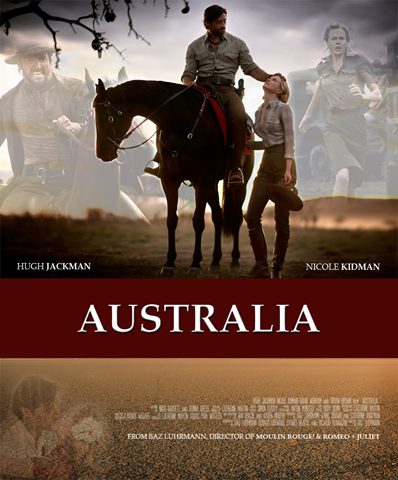
imageI spend most of my during Australia trying to counter my instinct to deconstruct its mythification. It seemed too easy to criticise the way it glossed over reality. Australia is, after all, an entertainment constructed to enchant the great southern land for a new generation. But there were two moments that left me feeling quite uneasy about the Australia that it constructed, particularly for a non-indigenous audience.

The plot of the film revolved largely around the plight of a young half-caste boy, Nulla. To a large degree, this was was the exclusive point of engagement with Aboriginal Australia. As such, it was a profoundly unequal relationship. While Nulla has a little magic at his disposal, he still needed the heroism of the Drover to save his life. The only reciprocal adult relationship was between the Drover and his ex-wife's brother, who taunted him that he didn't belong in this land. But the brother-in-law was removed from the plot, killed while valiantly defending the mission boys.

If I was a Freudian looking for an uncanny moment around while the film unravelled, then I would probably look to the scene when the Drover took charge of his promised stead, Capricornia. This horse differed from others primarily by its colour - jet black. The scene depicts the Drover manfully taming the wild energy of the horse, bringing it under his control and making it part of the business of the farm. It seems emblematic of what the film as a whole does, in subjugating the politically difficult indigenous cultures of Australia into a directorial spectacle. Why such a black horse? Why the absence of black men in the Australia that remained?

The second scene was at the very end. At first, I was relieved that Nulla was allowed to go walkabout with his grandfather. But the final words -- as I can remember them -- were along the lines of 'we are part of the same country, but you have your dreaming and I have mine.' So what did the film suggest was 'our' dreaming?

The overt non-indigenous myth in the film was the Wizard of Oz, which Nulla cleverly was able to elicit as a source of dreaming in the stiff English aristocrat. This choice of film was partly word play - on 'Oz' as the land of Australia and 'Somewhere over the Rainbow' as a reference to the rainbow serpent dreaming. But the Oz story itself reflected American cinema as a factory of dreams. As a product of this factory, Australia seemed more closely modelled on the American western than the tradition of local cinema. It had none of the eccentricity of the great Australian films of the 1970s. It was great to see an actor like Bruce Spence again, but he was left with a thinly stereotyped role, especially compared to the captivating appearance in Mad Max.

Apart from Hollywood as our dreamtime, the other major non-indigenous story was about the cattle industry. Surely at a time when we are more aware of the serious environmental degradation due to beef production, this seems hardly a pursuit on which to model Australia.

Maybe Australia is the last fruit of our spectacle culture. As financial realities knock down the economic house of cards, perhaps a new cinema will emerge to explore the cracks in the façade. After all, that's closer to home.

Friday, December 26, 2008

Gracias

image

Kevin Rudd reflecting on his encounter with the Sisters of Mercy mission helping indigenous Peruvians

Thank-you for advancing the task of global reconciliation between settled communities, settler communities and indigenous communities around the world.

'Remarks at Launch of the National Australia Bank Reconciliation Action Plan' Parliament House Canberra'   (1/12/2008)

The Tucumán connection

un amigo es como un hermano pero mejor, porque no heredás su ropa
Originally uploaded by quino para los amigos

We hear that the Queensland race relations policy was the inspiration for South African apartheid legislation. Here's another unfortunate southern connection.

The story of the cultural intervention of the sugar industry in the Calchaquí valley plays out as a perfect metaphor of the white Argentina myth. In Congress, Deputy Padilla and fellow Tucumán representative Juan Simón Padrós fought to obtain a legal recognition of the sugar industry as a “white industry.” This unusual label had nothing to do with the color of the product but with the ethnicity of the workers who toiled in fields and mills. Padilla and Padrós invoked the example of Australia, which in 1914 included the sugar industry under the “White Australia Act,” banning Aboriginal and Melanesian workers and receiving in compensation protective tariffs against cheap Javanese sugar. Argentines wanted similar protection against Cuban and Brazilian sugar, which, according to the industrialists’ twisted explanation, competed favorably with Tucumán sugar because of the exploitation of “inferior races.”86 Tucumán industrialists claimed to be forced to hire only white criollo workers, “whose higher living standards could not be compared to the colored workers of Java, Hawaii, etc.” The industrialists took pride in providing jobs for the large criollo population of the northwest but demanded a protective tariff in recognition of their patriotic commitment.

Oscar Chamosa 'Indigenous or Criollo: The Myth of White Argentina in Tucumán’s Calchaquí Valley' Hispanic American Historical Review 2008, 88: 1, pp. 71-106, p. 100

Tuesday, November 18, 2008

'From out part of the world...'

In Kevin Rudd's friendly chat about what's been happening at the G20 Summit, note how he opens his address, talking about the nations that were present. He talks about the 'US, other major economies around the world, and a lot from our part of the world as well...'

How refreshing to hear Australia linked to its neighbours. Is a subtle move away from the old idea of 'deputy sheriff', being the proxy for the more powerful countries in the distant north.

Sunday, August 24, 2008

Farewell to post-colonialism

The third Guangzhou Triennial is just about to open with a theme 'farewell to post-colonialism'. It is interesting to see their take on this. From the introduction:

For some years major international contemporary exhibitions around the world have worked towards building up ‘discursive sites for a cacophony of voices’ and ‘negotiated spaces of diverse values’, emphasising ‘correctness’ in cultural politics; these have inadvertently triumphed to the neglect of independent pursuit of artistic creativity and alternative imaginative worlds. Concepts of identity, multiplicity and difference are now slowly losing their edge to become new restrictions for artistic practice, succumbing to the phenomena of ‘false representation’ and ‘multi-cultural managerialism’.

It will be interesting to see if this is a departure from politics itself, towards what appears to be a large movement towards enchantment - the power of art not to change the world but to provide relief from it.

An alternative farewell to post-colonialism reflects the changing world order with previous victims of Western imperialism, like India and China, now aspiring to be active agents in the world order themselves. Perhaps this is part of it. Perhaps it doesn't need to be said.

Tuesday, July 29, 2008

Two sides of the Pacific

DSCN9023

Offered for exclusive tastes in Santiago is high class Australian meat cuisine.

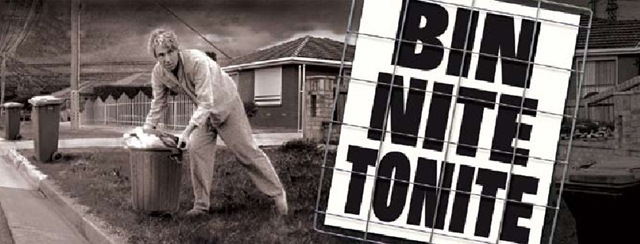
Bin night

Meanwhile, Melbourne artist Peter Burke is filling Altona billboards with the real drama on the streets of this southern city.

Dark clouds not on the horizon

DSCF3964

Within the liberal classes, we have become so used to our own sense of tolerance and cosmopolitanism, we may be blind to the danger of complacent insularity from within.

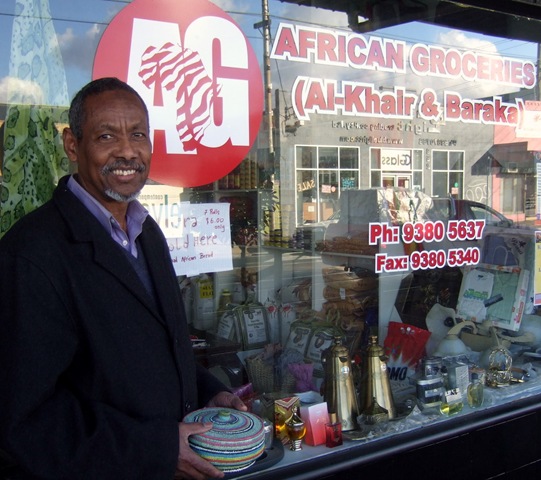
The People's Republic of Brunswick is a widely celebrated bastion of multiculturalism. After Italian, Greek and Arab, the latest region to add its culture to the suburb's diversity is African. In Lygon Street is the new store with goods and crafts from east Africa. Mahmoud Leman is here holding a bowl made by local Eritreans from recycled materials. His wife Halima Sheikhdin has been particularly involved in this activity.

I visited this store on my way to a 'town hall' meeting at the East Brunswick Hotel where a panel was discussing the latest plan for development in Brunswick. The hotel was packed to the gills with locals keenly interested to ensure that their suburb was protected from threats from outside. One of the proposals considered was a ring road to direct cars away from Brunswick.

Looking around at the crowd, it was hard to find anyone - including myself - who was not Anglo middle class. There were no Greeks or Africans present. While seeming noble in motive, reflecting a shared consensus in 'green' values, I couldn't repress a feeling of apprehension that this is a kind of middle class gentility whose hidden purpose is to ensure homogeneity. It's a terrible thought, which I attribute to some devil whispering in my ear. But I await the voice of the angel to dispute this.

And last night, I went to the surprise lecture of the next director of the Sydney Biennale, David Elliot. While celebrating 'impurity' in art, he actually contextualised this within the consciousness of the artist, rather than a critical engagement with impurity as we have seen in psychoanalysis or postcolonialism. The sense was that the free bohemian artist was above the crude divisions that exist in the world. This disengagement of art from the world (suggested partly in this year's Biennale) does not bode well for responses to climate change. Will re-localisation prove to create comfort zones for well-endowed elites?

Well, someone has to ask the question, if only to be proved wrong.

Sunday, July 27, 2008

Gubbaworld

DSCF3948

At Melbourne's Platform gallery is a curious exhibition for us commuters to reflect on our lack of belonging to the land.

Here's how Sharon West explains Gubbaworld:

Presenting colonial pseudo-histories and other follies
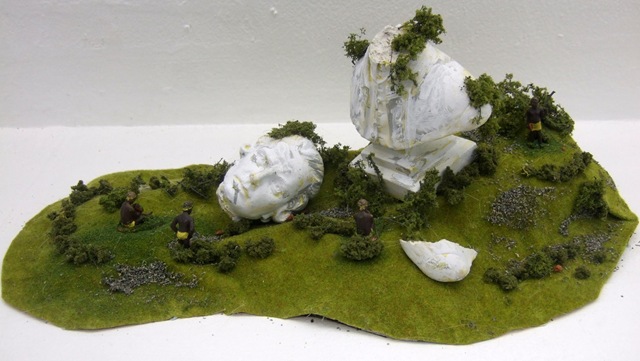
Gubbaworld is derived from the Koori name for white people. This exhibition parodies the notion of the museum diorama cabinet, offering pseudo narratives of Victorian settler history and draws reference on the Indigenous dioramas of Melbourne Museum and the Great Colonial Exhibitions of the late 1800s. The work themes also focus on settler and Indigenous contact, exploring parables and inversions that satirise the ideas of the great Southern land, the Noble Savage and white colonisation.

It's a humorous take on the naïve settler romance about native peoples. There's some reversals, as in the piece below, which put Koori's in the place of cultural tourists.

The effect of this exhibition is for us to laugh at the outmoded colonial movements, such as Jindyworabaks, who essentialised Indigenous cultures. But it does raise the question of where this places us today. Is the now official acknowledgement of Indigenous custodianship enough? Where do non-Indigenous now place themselves in this scene today?

DSCF3953A new Jerusalem
An attempt in the transplantation of British culture onto the Indigenous landscape. The Koori campsite is remodelled into a pleasant English village

Thursday, July 10, 2008

We're in, they're out

image

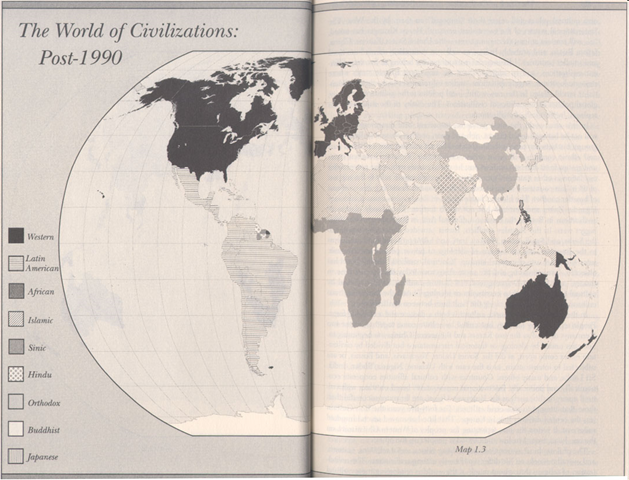
The Occidental is, primarily, the place of hegemonic epistemology rather than a geographical sector on the map. Samuel Huntington demonstrated as much when he placed Australia in the First World and in the West while leaving Latin America out.

Walter Mignolo The Idea of Latin America Oxford: Blackwell, 2005, p. 37

Wednesday, July 09, 2008

Two leaders of the South

Recently two leaders of southern nations have delivered lectures at the London School of Economics. Though both coming from ex-colonised on the other side of the world, and representing fresh democratic energies, they had very different stories to tell.

image The Australian Prime Minister Kevin Rudd started his address on 7 April with jokes about the Australian superiority in cricket. His 'colonial strut' reflected a young boisterous nation goading its slow-moving but beloved parent. The speech was an opportunity to outline Britain's relation to the aspiration that Australia be the 'most Asia-literate nation in the collective West.' He made an emphatic point that:

Today I want to argue that, in a rapidly changing world, Australia and the United Kingdom have a lot to gain from working with each other to shape the emerging global order – particularly given Britain’s strength in Europe and Australia’s standing in Asia.

So here is the arrangement of the two close Anglo nations within the collective West. Britain looks after Europe, and Australia looks after Asia. The assumption is that the collective West is the principle actor on the world stage, steering history on a safe course. No doubt this assumption will be seriously challenged in future years.

image Three days before, the Chilean President Michelle Bachelet addressed the LSE about the situation in her country. It began as a very serious talk, emphasising issues of statecraft and the role of the government in transcending competing interests between different groups. While a little dry, she had some interesting things to say about the challenge to confront the culture of political belligerence and create a civic discourse in which opposing points of view can debate calmly. Towards the end, she started to make some jokes in a way far more spontaneous than Rudd. There was no reference to Britain whatsoever in her talk.

As she left he podium, Bachelet was presented with a cup similar to that given to Nelson Mandela. As another leader of the South, was Rudd given a similar gift?

Sunday, July 06, 2008

Betancourt's release - it's not all good news

image

So after six years in jungle captivity, Ingrid Betancourt is finally released. Certainly, one can only share the joy of her release, the relief of a painless rescue and the ecstasy of a family re-united.

But there's also case for some regret. One of Betancourt's first acts on release is to fly to France and express her appreciation for the support of the French people, particularly the President, Nicolas Sarkosy. 'I owe my life to France', she says.

It seems a strange statement for her to make. France apparently had no role in the rescue operation. It was the Colombians who risked their lives for her.

The immediate flight to France, where she has begun to give details of the horrors of the Colombian jungle, can only confirm the belief in most first world counties of the lawlessness and barbarity of the South.

There are many references in the story of her rescue to a Hollywood script. It's as though she was saved not by real soldiers but by Stephen Spielberg. The way the story has been told is testimony to the cultural hegemony of the West, and the fantasy of world redemption that is enacted in US action films.

So, despite the joy of Betancourt's reunion with family and friends, I feel a twinge of regret that this episode only confirms the hierarchy of North and South - the powerful, civilised force of the North, pitted against the disorganised, barbaric forces of the South.

It reaffirms the aspirational perspective of the South, where the lucky few who are able to escape are lauded as great national heroes.

None of this counters the pleasure in Betancourt's release. I just wish she would have stayed in Colombia.