Cultural Translations: Remaking the Early European Past in Australasia
Sponsored by the Network for Early European Research
2-3 November, 2006
State Library of Victoria, Melbourne
Convenors: Dr Peter Holbrook (University of Queensland) and Professor Stephanie Trigg (University of Melbourne)The Cultural Translations symposium will for the first of its kind: an attempt to think through, across a range of disciplines, the nature of Australasian encounters and engagements with the medieval and early modern British and European pasts.
The symposium has two broad themes. The first relates to the issue of British and European cultural memory in Australasia. What roles have the cultural, aesthetic, literary, legal, constitutional, political-ideological, religious and social discourses and practices of medieval and early modern Britain and Europe played in the settler-colonial societies of Australia and New Zealand? What has been the relation of these societies to the medieval and early European past? what uses have nationalist discourses in these societies found, or failed to find, in medieval and early modern cultural moments? What have been the broader cultural politics of remembering in a multicultural, postcolonial, and globalized twenty-first century Australasia?
A second theme is in some ways more empirical and concerns scholarship, or how the early European past has in practice been reconstructed by scholars and intellectuals in Australia and New Zealand. What precise contributions to the study and interpretation of these key phases in the history of Western civilization have been made by scholarship in Australia and New Zealand? Have there been particular distinguishing characteristics of Australasian scholarship-in any field-on these civilizational moments? What function has the study of Medieval, Renaissance, or Enlightenment cultural and intellectual modes and movements played in the political, social, and cultural life of Australasia? What role have particular scholars, institutions (schools, universities, museums, churches, parliaments), or practices (antiquarianism, collecting, editing and bibliography, curatorship) devoted to the British or European medieval or early modern played in Australia or New Zealand?
All welcome.
Invited speakers include:
Geraldine Barnes (University of Sydney)
Tom Bishop (University of Auckland)
Glenn Burgess (University of Hull)
Conal Condren (University of New South Wales)
Leigh Dale (University of Queensland)
Robert Dixon (University of Queensland)
Louise D'Arcens (University of Wollongong)
John Frow (University of Melbourne)
John Gascoigne (University of New South Wales)
Ian Hunter (University of Queensland)
Andrew Lynch (University of Western Australia)
The combined expertise of this group ranges across such fields as English Literature, Political and Intellectual History, the History of Art, Cultural Studies, Australian Studies, and Postcolonial Studies. In regards to historical reach, its expertise ranges from the medieval period to the Eighteenth Century, and to the history of Australasia. We think it particularly exciting that the symposium will provide an opportunity for members of such a variety of disciplines to talk to each other about the meaning of the European past in Australasia.
Detailed abstracts of the papers will be available on the symposium Web site by the beginning of September. If you would like to be part of the programme as a formal respondent, please let us know.
NEER will provide financial assistance to postgraduate students and early career researchers wishing to attend this symposium.
For any inquiries, please contact the Cultural Translations Administrative Assistant, Helen Hickey University of Melbourne (T: +61 3 8344 5506, F: +61 3 8344 5494, E: h.hickey@pgrad.unimelb.edu.au)
http://www.english.unimelb.edu.au/FrontPageDoc/CulturalTranslations.html/
Saturday, August 26, 2006
Looking towards a medieval Australia


Saturday, August 19, 2006
Alex Buzo dies
 Australian-Albanian author Alex Buzo passed away this week. Here's a brief extract from Neverland and makes reference to his views.
Alex Buzo’s Norm and Akif
The sudden reversal from warm hospitality to cold expulsion evokes a fear of difference that seems buried deep in the Australian psyche. Akif’s own plight had been anticipated in dramatic form by Alex Buzo, who is Australia’s most prominent person of Albanian stock. Buzo’s father was born in the ancient Albanian town of Berat in 1912 and was educated in American schools before arriving in Australia in the 1930s. The name ‘Buzo’ means ‘diver’ in Spanish. Alex Buzo’s mother was of Irish descent.
Buzo’s first play, Norm and Ahmed (1968), anticipated the denouement of the Kosovar’s Australian reception. A construction worker asks for a light from a passing Pakistani student. The ocker host tries to loosen up this deferential visitor and introduce him to Australian ways, but he is intimidated by the student’s formal way of speaking. With almost sadistic pleasure, Buzo lures the audience into thinking that there is some real rapprochement occurring. This is swiftly undermined in the final moment of the play, where Norm dispatches the Pakistani with the epitaph ‘fuckin’ boong’.
The play was recently revised as Normie and Tuon (1999); the foreigner has become a Vietnamese, who confronts a war veteran. Buzo compares the friendly/hostile switch to the Kosovar story: ‘The big thing in the Kosovar case was the lack of perceived gratitude.’ Despite the parallel theme, and his Albanian ancestry, Alex Buzo has never been called on to speak about the Kosovar refugees. He is better known as an expert on the peculiarities of Australian culture, with publications such as Real Men Don't Eat Quiche and A Dictionary of the Almost Obvious. In this respect, Buzo is a prime candidate for the position of ‘Albanian for the other’. With gentle mockery, he documents the idiosyncrasies of Australian culture.
Buzo is a proud nationalist; his 1972 play Macquarie passionately upholds the reputation of Governor Macquarie above the mean-spirited policies of Samuel Marsden. Yet at the same time, there is a fatalism running through Buzo’s writing about the possibility of reconciliation between Aussie and foreigner. His pessimism remains a challenge to the bright-eyed parade of Aussie icons that stands for national pride.
(Image to the left is the cover of the Herald Sun when Victoria opened its hearts to the Kosovar refugees. The first, and perhaps only, time that the tabloid has sported a headline in Albanian.}
Australian-Albanian author Alex Buzo passed away this week. Here's a brief extract from Neverland and makes reference to his views.
Alex Buzo’s Norm and Akif
The sudden reversal from warm hospitality to cold expulsion evokes a fear of difference that seems buried deep in the Australian psyche. Akif’s own plight had been anticipated in dramatic form by Alex Buzo, who is Australia’s most prominent person of Albanian stock. Buzo’s father was born in the ancient Albanian town of Berat in 1912 and was educated in American schools before arriving in Australia in the 1930s. The name ‘Buzo’ means ‘diver’ in Spanish. Alex Buzo’s mother was of Irish descent.
Buzo’s first play, Norm and Ahmed (1968), anticipated the denouement of the Kosovar’s Australian reception. A construction worker asks for a light from a passing Pakistani student. The ocker host tries to loosen up this deferential visitor and introduce him to Australian ways, but he is intimidated by the student’s formal way of speaking. With almost sadistic pleasure, Buzo lures the audience into thinking that there is some real rapprochement occurring. This is swiftly undermined in the final moment of the play, where Norm dispatches the Pakistani with the epitaph ‘fuckin’ boong’.
The play was recently revised as Normie and Tuon (1999); the foreigner has become a Vietnamese, who confronts a war veteran. Buzo compares the friendly/hostile switch to the Kosovar story: ‘The big thing in the Kosovar case was the lack of perceived gratitude.’ Despite the parallel theme, and his Albanian ancestry, Alex Buzo has never been called on to speak about the Kosovar refugees. He is better known as an expert on the peculiarities of Australian culture, with publications such as Real Men Don't Eat Quiche and A Dictionary of the Almost Obvious. In this respect, Buzo is a prime candidate for the position of ‘Albanian for the other’. With gentle mockery, he documents the idiosyncrasies of Australian culture.
Buzo is a proud nationalist; his 1972 play Macquarie passionately upholds the reputation of Governor Macquarie above the mean-spirited policies of Samuel Marsden. Yet at the same time, there is a fatalism running through Buzo’s writing about the possibility of reconciliation between Aussie and foreigner. His pessimism remains a challenge to the bright-eyed parade of Aussie icons that stands for national pride.
(Image to the left is the cover of the Herald Sun when Victoria opened its hearts to the Kosovar refugees. The first, and perhaps only, time that the tabloid has sported a headline in Albanian.} 
Saturday, July 01, 2006
Woven opening
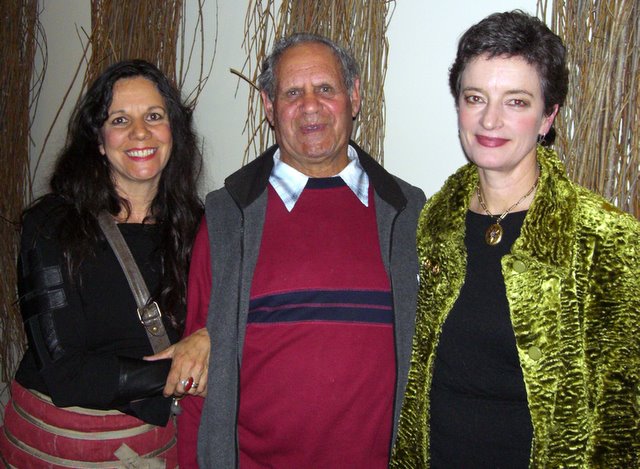 Opening of Woven by Gayle Maddigan and Megan Evans at Ballarat Fine Art Gallery 30 June 2006
This exhibition is a wonderful meeting of opposites—the outside of public art and the inside of the art gallery, the ground on which we stand as individuals and the stars that bring us together, the fifth generation Australian artist, and an artist whose people have been here for thousands of generations. Interesting things happen when you bring these opposites together.
We normally understand the earth as the land we travel, and the stars as lights that guide our journey. But a little over fourteen years ago, Australia was blessed by a different knowledge. In the ground-breaking Mabo case (literally), the Australian High Court decided in favour of the people of Mer, the Meriam people, who followed the teachings of the ancestor Malo, which assigned rules of land tenure, succession and trespass. Witnesses such as Koiki Mabo for the Mer invoked the allegorical expression ‘Stars follow their own path . . .’ when giving their testimony. History may prescribe certain twists and turns in the fate of mankind, but the underlying rules of culture remain constant, just as stars follow their own path.
Of course, this evening we are following the path of the southern cross. In fact, I came here from the newly renamed Southern Cross Station, launched by the Ballarat-born Premier Steve Bracks as a symbol of multiculturalism. We saw the ongoing energy of that symbol on Wednesday at the Workers Rights Rally, when United Firefighters Union of Australia state secretary Peter Marshall, a rally organiser, urged the crowd to repeat rebellion leader Peter Lalor’s oath: ‘We swear by the Southern Cross to stand truly by each other and fight to defend our rights and liberties.’
So ingrained is the Southern Cross symbol in our sense of what is worth fighting for, that we can be excused for forgetting that the stars belong to no one story. They are a bridge between cultures.
One of the wonders of the South Project is finding such links between countries that have been separated by the very thing they share in common. Like the flightless birds that grace our lands, countries like Australia and Brazil are so used to looking north that we don’t see each other. We only need to look up to the stars.
This fact is very much in our face at the moment as we see the Brazilian flag proudly waved at the World Cup. The flag features the night sky above Rio as it was on 10:30am 15 November 1889. We can find the southern cross in the flags of New Guinea, New Zealand, Samoa...
But my favourite story of the Southern Cross originates right here. As recorded by the grazier William Stanbridge, to the Philosophical Institute in Melbourne in 1857, the Boorong people see in the southern constellation a tree which protects Bunya, an opossum, who is pursued by Tchingal, an emu, represented by the Coal Sack. The Pointers are the two great hunters who kill the emu and their spears are stuck in the tree.
A common feature of various Aboriginal stories of the stars is a tree that enables its heroes to move between heaven and earth. The connection between trees and the stars they point to is quite powerful in this exhibition. The artists have approached the link from many different angles. Gayle Maddigan has used the ash from the burnt branches to create quite visceral drawings on paper. Megan Evens has adopted a more craft-life approach in her meticulous oil paintings of gigantic leaves. Together they have produced an amazingly powerful white ochre landscape painted directly on the gallery wall opposite the Eureka flag. Woven is a wonderful journey that takes us back through the trauma of invasion to the timeless values of indigenous Australia. Here is a path for stars, and for us to guide our way to the future.
I would like to conclude with four lines from Dante’s Divine Comedy, when we finally meets his beloved Beatrice:
[Canto XXXIII] From that most holy wave I now returned
to Beatrice; remade, as new trees are
renewed when they bring forth new boughs, I was
pure and prepared to climb into the stars
Alighieri Dante The Divine Comedy (trans. Eugenio Montale) : Everyman Books, 1985 (orig. 1313), p. 375
Image of Gayle Maddigan, elder Murray Harrison and Megan Evans
Opening of Woven by Gayle Maddigan and Megan Evans at Ballarat Fine Art Gallery 30 June 2006
This exhibition is a wonderful meeting of opposites—the outside of public art and the inside of the art gallery, the ground on which we stand as individuals and the stars that bring us together, the fifth generation Australian artist, and an artist whose people have been here for thousands of generations. Interesting things happen when you bring these opposites together.
We normally understand the earth as the land we travel, and the stars as lights that guide our journey. But a little over fourteen years ago, Australia was blessed by a different knowledge. In the ground-breaking Mabo case (literally), the Australian High Court decided in favour of the people of Mer, the Meriam people, who followed the teachings of the ancestor Malo, which assigned rules of land tenure, succession and trespass. Witnesses such as Koiki Mabo for the Mer invoked the allegorical expression ‘Stars follow their own path . . .’ when giving their testimony. History may prescribe certain twists and turns in the fate of mankind, but the underlying rules of culture remain constant, just as stars follow their own path.
Of course, this evening we are following the path of the southern cross. In fact, I came here from the newly renamed Southern Cross Station, launched by the Ballarat-born Premier Steve Bracks as a symbol of multiculturalism. We saw the ongoing energy of that symbol on Wednesday at the Workers Rights Rally, when United Firefighters Union of Australia state secretary Peter Marshall, a rally organiser, urged the crowd to repeat rebellion leader Peter Lalor’s oath: ‘We swear by the Southern Cross to stand truly by each other and fight to defend our rights and liberties.’
So ingrained is the Southern Cross symbol in our sense of what is worth fighting for, that we can be excused for forgetting that the stars belong to no one story. They are a bridge between cultures.
One of the wonders of the South Project is finding such links between countries that have been separated by the very thing they share in common. Like the flightless birds that grace our lands, countries like Australia and Brazil are so used to looking north that we don’t see each other. We only need to look up to the stars.
This fact is very much in our face at the moment as we see the Brazilian flag proudly waved at the World Cup. The flag features the night sky above Rio as it was on 10:30am 15 November 1889. We can find the southern cross in the flags of New Guinea, New Zealand, Samoa...
But my favourite story of the Southern Cross originates right here. As recorded by the grazier William Stanbridge, to the Philosophical Institute in Melbourne in 1857, the Boorong people see in the southern constellation a tree which protects Bunya, an opossum, who is pursued by Tchingal, an emu, represented by the Coal Sack. The Pointers are the two great hunters who kill the emu and their spears are stuck in the tree.
A common feature of various Aboriginal stories of the stars is a tree that enables its heroes to move between heaven and earth. The connection between trees and the stars they point to is quite powerful in this exhibition. The artists have approached the link from many different angles. Gayle Maddigan has used the ash from the burnt branches to create quite visceral drawings on paper. Megan Evens has adopted a more craft-life approach in her meticulous oil paintings of gigantic leaves. Together they have produced an amazingly powerful white ochre landscape painted directly on the gallery wall opposite the Eureka flag. Woven is a wonderful journey that takes us back through the trauma of invasion to the timeless values of indigenous Australia. Here is a path for stars, and for us to guide our way to the future.
I would like to conclude with four lines from Dante’s Divine Comedy, when we finally meets his beloved Beatrice:
[Canto XXXIII] From that most holy wave I now returned
to Beatrice; remade, as new trees are
renewed when they bring forth new boughs, I was
pure and prepared to climb into the stars
Alighieri Dante The Divine Comedy (trans. Eugenio Montale) : Everyman Books, 1985 (orig. 1313), p. 375
Image of Gayle Maddigan, elder Murray Harrison and Megan Evans
Sunday, April 30, 2006
Martin Flanagan on South Africa
From Martin Flanagan's Age article, Straight shooting:
I don't know if I could live in South Africa. You'd need strong nerves. But I do know there is something in what Max du Preez said at the end of his book. South Africa has problems far greater than this country's, but in South Africa you keep coming across a great invigorating passion for the future that is unlike anything here. We equate nationalism with beating the drum on Anzac Day and playing up sporting wins. They have people like the little man who took us through Soweto.
I don't know if I could live in South Africa. You'd need strong nerves. But I do know there is something in what Max du Preez said at the end of his book. South Africa has problems far greater than this country's, but in South Africa you keep coming across a great invigorating passion for the future that is unlike anything here. We equate nationalism with beating the drum on Anzac Day and playing up sporting wins. They have people like the little man who took us through Soweto.
Sunday, April 23, 2006
Ngapartji Ngapartji
Ngapartji Ngapartji a course/performance on the Pitjantjatjara language is know calling for pparticipants.
awelye
From article about Cassandra Fahey:
During a leisurely drive to the Healesville Sanctuary to see the seductively named platypusary, Fahey's musings on work, life, love and spirituality suggest someone who is instinctive, uninhibited and inspired by the big, hazy picture. She cites nature and the work and thoughts of Aboriginal painter Emily Kame Kngwarreye among her key influences.
"When badgered by white people, collectors and so forth to name her works, (Emily) always said awelye, and she said that meant 'the whole bang lot' . . . and this is beautiful," Fahey says, with a certain longing. "This is such an incredibly positive thing that Australian Aboriginality has that we just struggle to get."
Talking architecture and life with Fahey is a little like getting "the whole bang lot".
Wednesday, April 05, 2006
Jorge Malley watch
The notorious Jorge Malley has surfaced again in the trendy online magazine New Matilda. Jorge is suspected to be one of a long line of literary hoaxes that have dogged Australian culture. His latest entry, a confabulation about the Queen moving to Australia, is an underhand attack on the proud Republican aspirations of our country. Though the prospect of having our own head of state does seem impossible, we should still live in hope. Who is Jorges Malley? I suspect some monarchist smirking at Australia's fraught future.
Monday, April 03, 2006
Light at the end of the temple
I wondered into Notre Dame Cathedral with what seemed like a few minutes spare in my life. Here was a moment to luxuriate in a seeming vast expanse of time. I joined a stream of tourists that circulated around the margins of the cathedral. I was first struck by the dishes of candles, glittering in the darkness. Beyond that, believers were sitting patiently waiting to go to confession. Rather than opaque boxes, these confessions were now heard within glass doors. I wondered further with my fellow tourists and eventually settled on a pew down the rear of the church at a small chapel. At first, I was struck by the intense devotion of the several believers, kneeling in prayer. But then I began to be aware of the flashes illuminating the chapel at irregular intervals. Along with the constant shuffle of comfortable shoes behind me was a series of random flashes as digital pilgrims drank in the darkness. Some of the flashes were not single. They were preceded by a faint red flash before two flashed went off in short succession. I realised that their cameras were set on red eye. Not only would flashes be incapable of reaching the dark cavities of the chapel, you certainly wouldn’t expect any eyes looking back at you.
After a while, there seemed an odd balance between the intense stillness of religious devotion and the restless hunger of the digital cameras. Were they praying for the cameras to stop? Were the tourists challenged by the believers to break their concentration?
As a global tourist centre, the Notre Dame cathedral seemed like a flashpoint for the monstrous consumer spectre that has gripped late capitalism. We are like a creature who can no longer bear experience in the real. We need the small screens on the backs of cameras and mobiles to filter reality into snaps. We are masticating the real world and absorbing into our digital bowels. These cameras are like rear view mirrors constantly before us, guiding our journey through the spectacle.
I stood transfixed at the spectacle of the spectacle. Tourists paused at the main vestibule with their silver hearts with glowing green eyes, holding the camera up to the sublime ceiling, flashing into the void, and then gazing back into the preview screens, then shuffling on.
It was ceaseless. I must have stood for about twenty minutes until the organ began resonating through the cathedral, following by a sublime solo female voice. A line of elderly people filed to the side of the altar, the women dressed in black lace and the men in white vestments with ornate Latin lettering. A phalanx of priests followed and finally the bishop arrived and gave his blessing to the congregation. It was the first anniversary of Pope John Paul’s death. Incense poured through the church.
I was swept up by the spectacle. I was distracted from the cameras and beholden to the gravitas of the catholic mass, my entire body covered in goose bumps. Then it happened. My phone started ringing. I tried to ignore it, but my message back must not have been working and they kept ringing. I was being drawn away from the mass and back into the river of tourism spilling out of the church. On my way out I looked back. Then I saw it. Every pillar had a flat screen showing close-ups of the service. The camera looked back. It was quite awesome.
I left the cathedral, chastened.
Sunday, March 19, 2006
From one traditional owner to another
From one traditional owner to another
The Melbourne Commonwealth Games opening ceremony bore close resemblance to Sydney’s epic spectacle six years previously. Both events gave Indigenous Australia a significant profile and used an innocent child to make the link with non-Indigenous Australia. In Melbourne, Nicki Webster was replaced by a young boy holding a duck. Clearly, these spectacles require some kind of link to connect its original inhabitants with majority white Australia. However, in the absence of a treaty, it is simpler to use a child without any adult history as the point of connection with Aboriginal culture. It seems we are still not mature enough to have an adult relationship between the two worlds. Any attempt to mature this relationship on the grand stage would only make more obvious the lack of treaty in our history.
In Melbourne, the absence of real connection with Aboriginal Australia was made additionally obvious in the second boy’s role. The young ambassador from Plan Australia described the queen as the ‘glue’ that keeps the Commonwealth together. Clearly, cultural dialogue, shared colonial experience and common humanity is not enough. Mother England still holds us together.
But there are signs that the royals might be a touch impatient for Australia to loosen its hold on the apron strings. Last Saturday, I was lined up to have a conversation with the youngest son, Prince Edward. I introduced him to the Common Goods exhibition, pointed out the 100th Anniversary of Gandhi’s passive resistance campaign and the way Indian darners had honoured our proud Eureka flag. In the face of a proud republican tradition, the Prince exclaimed ‘Smashing!’
Minutes later, he was at the podium opening the Spirit of the Games exhibition, at the Melbourne Museum. The crowd hushed in respect as the Earl of Wessex entered the room. Before welcoming the Prince, the Museum Director Dr Patrick Greene acknowledged the traditional owners of the land, the people of the Kulin nation. He was followed by the Premier Steve Backs, how also commenced with the same script. Then Arts & Sport Minister Rod Kemp spoke about the joys of combining both ministries. Finally, Museum chair Harold Mitchell acknowledged traditional owners and then mentioned the real chair on which the ‘little old lady’ sat that is now on display (to gasps of horror in the audience). Finally, Prince Edward took to the podium, fresh-faced and without notes. And even he began with the refrain ‘I would like to acknowledge the original…’ he hesitated for a second before correcting himself, ‘…traditional owners of the land’. Steve Bracks looked particularly pleased at this royal acknowledgment.
While Australia’s future as a republic seems on indefinite hold, the symbolic status of indigeneity is now rivalling the English monarchy as a way of legitimating our identity.
The Melbourne Commonwealth Games opening ceremony bore close resemblance to Sydney’s epic spectacle six years previously. Both events gave Indigenous Australia a significant profile and used an innocent child to make the link with non-Indigenous Australia. In Melbourne, Nicki Webster was replaced by a young boy holding a duck. Clearly, these spectacles require some kind of link to connect its original inhabitants with majority white Australia. However, in the absence of a treaty, it is simpler to use a child without any adult history as the point of connection with Aboriginal culture. It seems we are still not mature enough to have an adult relationship between the two worlds. Any attempt to mature this relationship on the grand stage would only make more obvious the lack of treaty in our history.
In Melbourne, the absence of real connection with Aboriginal Australia was made additionally obvious in the second boy’s role. The young ambassador from Plan Australia described the queen as the ‘glue’ that keeps the Commonwealth together. Clearly, cultural dialogue, shared colonial experience and common humanity is not enough. Mother England still holds us together.
But there are signs that the royals might be a touch impatient for Australia to loosen its hold on the apron strings. Last Saturday, I was lined up to have a conversation with the youngest son, Prince Edward. I introduced him to the Common Goods exhibition, pointed out the 100th Anniversary of Gandhi’s passive resistance campaign and the way Indian darners had honoured our proud Eureka flag. In the face of a proud republican tradition, the Prince exclaimed ‘Smashing!’
Minutes later, he was at the podium opening the Spirit of the Games exhibition, at the Melbourne Museum. The crowd hushed in respect as the Earl of Wessex entered the room. Before welcoming the Prince, the Museum Director Dr Patrick Greene acknowledged the traditional owners of the land, the people of the Kulin nation. He was followed by the Premier Steve Backs, how also commenced with the same script. Then Arts & Sport Minister Rod Kemp spoke about the joys of combining both ministries. Finally, Museum chair Harold Mitchell acknowledged traditional owners and then mentioned the real chair on which the ‘little old lady’ sat that is now on display (to gasps of horror in the audience). Finally, Prince Edward took to the podium, fresh-faced and without notes. And even he began with the refrain ‘I would like to acknowledge the original…’ he hesitated for a second before correcting himself, ‘…traditional owners of the land’. Steve Bracks looked particularly pleased at this royal acknowledgment.
While Australia’s future as a republic seems on indefinite hold, the symbolic status of indigeneity is now rivalling the English monarchy as a way of legitimating our identity.
Friday, February 24, 2006
Performance in Lygon Street
 I came across this radical collective in a South American restaurant, Lygon Street. Obviously an issue that the Melbourne locals feel passionately about.
Thursday, January 05, 2006
A roar from the white fortress
It is sickening that the most disgusting remnants of South African racists have found refuge in Australia, where they can yell out the kinds of words that would now get them lynched back where they came from. Is this our most visible connection with South Africa?
Racial abuse interrupts Test match - Cricket - Sport - theage.com.au
"The South African paceman, a target of crowds because of his colourful antics, was among the five Proteas players racially abused during the first Test in Perth. Makhaya Ntini, South Africa's first black Test cricketer, along with Shaun Pollock, Ashwell Prince, Garnett Kruger and Justin Kemp were called "kaffirs", a derogatory term for indigenous South Africans, or "kaffir boeties", a spiteful term for whites friendly with blacks, by a drunken section of the WACA crowd."
I have written a letter to the South African High Commissioner apologising on behalf of the Australian people.
Friday, December 23, 2005
Melb-Italy
Things are so Latin-centric at the top end of town that a new bar has opened in Flinders Lane calling itself Tazio. It offers the three facilities: birraria, pizzeria, cucina. Much better than 'bar, pizza, kitchen', eh?
Sunday, September 11, 2005
Going back home
Tuesday, August 30, 2005
Sunday, August 21, 2005
White women from Africa
There have been two films recently that celebrate the African value of forgiveness. The Interpreter with Nicole Kidman concerns a fictional African country Motabo and the culture of Koo who grant the family of a murder victim the opportunity to 'save' the life of the murderer. And In My Country, based on the book by Antjie Krog, features Juliet Binoche playing a journalist trying to teach an American about the African value of forgiveness in Ubuntu. Why is it that potentially liberating aspects of African culture are brought to our screens by these whiter than white heroines? Does this provide us with a door to Western intervention in Africa, seeing its core values represented best not by its black inhabitants but by its white women?
Sunday, August 07, 2005
Going Balanda
 L. Leichardt (1845) Journal Overland Expedition. They knew the white people of Victoria, and called them Balanda, which is nothing more than 'Hollanders'; a name used by the Malays, from whom they received it
[Image of Dutch Masters exhibition, National Gallery of Victoria]
L. Leichardt (1845) Journal Overland Expedition. They knew the white people of Victoria, and called them Balanda, which is nothing more than 'Hollanders'; a name used by the Malays, from whom they received it
[Image of Dutch Masters exhibition, National Gallery of Victoria]
Sunday, July 31, 2005
Faranji
 In the Divehi language spoken by the people of Maldives, the word for white person is 'faranji'. This applies to most imported goods and those of non-Muslim beliefs. Among items forbidden in the Maldives are: alcohol, idols and dogs.
Sunday, June 12, 2005
Oyimbo
A word for non-indigenous in Nigeria seems to be 'oyimbo', the source of complaint about the hardship faced by Nigeria migrants in the west:
"Every day our doctors go there and end up washing plates for oyimbo because oyimbo does not think we study medicine right. Our lawyers go and drive taxis because oyimbo does not trust how we train them in law."
Chimamanda Ngozi Adichie Purple Hibiscus London: Harper, 2005
Tuesday, June 07, 2005
Johannesburg
 Michael is a recent arrival from Mozambique. He has perched on the edge of a craft market in Newtown with his hand-built architecture. His buildings are made out of grass that has been varnished and his housing block is made out of black cardboard. Michael is very particular about the way the rooms are planned within the house. He doesn't seem to have a definite plan of what he is going to do in Johannesburg. For the time being, he is eking a living making models of the architecture that he doesn't yet enjoy himself.
Sunday, April 24, 2005
 It was difficult to imagine the degree to which people lived then in the shadow of poetry. It was a frenzied passion, another way of being, a fireball that went everywhere on its own. We could open the paper, even the business section or the legal page, or we would read the coffee grounds at the bottom of the cup, and there was poetry waiting to take over our dreams. So that for us aborigines from every province, Bogotá was the capital of the country and the seat of government, but above all it was the city where poets lived.
Gabriel García Marquez Living To Tell The Tale London: Jonathan Cape, 2003
It was difficult to imagine the degree to which people lived then in the shadow of poetry. It was a frenzied passion, another way of being, a fireball that went everywhere on its own. We could open the paper, even the business section or the legal page, or we would read the coffee grounds at the bottom of the cup, and there was poetry waiting to take over our dreams. So that for us aborigines from every province, Bogotá was the capital of the country and the seat of government, but above all it was the city where poets lived.
Gabriel García Marquez Living To Tell The Tale London: Jonathan Cape, 2003
Subscribe to:
Posts (Atom)